
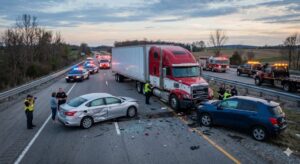

Large trucks account for a disproportionate share of fatal road accidents. Despite representing only a fraction of registered vehicles, they are involved in roughly one in ten traffic fatalities, according to National Highway Traffic Safety Administration (NHTSA) data. Their sheer size and weight create hazards that ordinary passenger vehicle crashes simply cannot replicate. The legal and logistical aftermath can be equally overwhelming, which is why victims often benefit from consulting a truck accident lawyer to navigate the complexities of liability and compensation. Understanding what causes these crashes, how they affect survivors, and what steps to take afterward can arm every road user with potentially life-saving knowledge.
Common Causes of Large Truck Crashes
Several interconnected factors make large trucks uniquely dangerous on public roads. Fatigue remains one of the most well-documented contributors—commercial drivers routinely cover hundreds of miles per shift, and drowsiness can sharply impair both reaction time and judgment. Distracted driving, whether from mobile devices or in-cab navigation systems, only compounds that risk. Brake failure is another serious concern: the enormous loads trucks carry place extraordinary stress on braking components, and neglected maintenance can turn a minor mechanical issue into a catastrophic one. Tire blowouts, improper cargo loading, deteriorating road conditions, and adverse weather round out the most common external contributors.
Top 5 preventable causes at a glance:
- Driver fatigue – reduced alertness from extended hours behind the wheel
- Distracted driving – attention diverted from the road by devices or surroundings
- Brake and mechanical failure – components worn down by heavy loads and neglected maintenance
- Improper cargo loading – unbalanced or unsecured freight that shifts during transit
- Unsafe interactions with smaller vehicles – passenger cars entering blind spots or cutting off trucks
The Severe Impacts of Truck Crashes
A fully loaded commercial truck can weigh up to 80,000 pounds—roughly 20 to 30 times the mass of a standard passenger car. Physics alone explains why these collisions generate such catastrophic energy transfer. Common injuries include traumatic brain injuries, spinal cord damage, and severe internal trauma, with fatality rates significantly higher than those seen in car-only crashes, as confirmed by Insurance Institute for Highway Safety (IIHS) research.
The economic fallout compounds the physical toll. Medical treatment, rehabilitation, lost income, and vehicle replacement costs frequently climb into six figures. Long-term consequences—chronic pain, post-traumatic stress disorder (PTSD), and lasting family disruption—extend the damage well beyond the crash site itself.
Key Takeaway: Truck crashes inflict outsized harm because of mass, speed, and structural disparity. Even a relatively low-speed collision can produce injuries that permanently alter a victim’s quality of life.
Prevention Strategies for Safer Roads
Reducing the frequency of truck crashes requires effort from both commercial operators and everyday drivers. Here are five actionable steps anyone can take:
- Maintain a safe following distance – trucks require significantly longer stopping distances than passenger cars.
- Avoid blind spots (“No-Zones”) – stay clear of areas directly behind, in front of, and alongside large trucks.
- Signal intentions early – abrupt lane changes near trucks leave virtually no margin for error.
- Support fleet compliance – electronic logging devices (ELDs) enforce federal hours-of-service rules under FMCSA regulations, directly reducing fatigued driving.
- Advocate for collision avoidance technology – automatic emergency braking systems have demonstrated measurable reductions in rear-end crashes.
What to Do Immediately After a Truck Crash
Acting decisively in the aftermath of a crash protects both your safety and your legal standing:
- Move to safety if possible without worsening any injuries.
- Call emergency services immediately.
- Document the scene thoroughly—photographs, witness contact information, and truck identification numbers are all valuable.
- Notify your insurer promptly while preserving all related records.
- Avoid admitting fault or signing any statements under pressure.
- Request preservation of the truck’s event data recorder (EDR)—this black-box data is critical evidence that can be lost permanently if not secured quickly.
Final Reflections on Road Safety and Preparedness
Large truck crashes are serious events, but they are largely preventable. Awareness of their causes, a genuine respect for their consequences, and a clear plan for response can make a meaningful difference. Every driver who maintains a safe following distance, every fleet operator who prioritizes maintenance, and every regulator who enforces compliance contributes to fewer tragedies on our roads. Take a moment to review your own driving habits, stay informed on road safety developments, and remember that safer highways are a shared responsibility—built one informed decision at a time.