
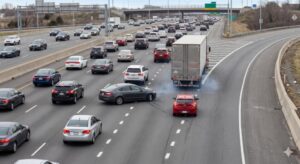

Merging is different from other driving maneuvers because, when it is done in an unsafe manner, the motorist does not usually have time to make corrections. When someone is merging too slowly or changes lanes very quickly, other motorists may need to hit the brakes hard or crash into another vehicle. If this happened to you and you suffered from a spinal cord injury, you must hire a car accident lawyer to get help filing a spinal cord injury claim.
Why Is Merging Unsafe?
Merging is unsafe because motorists must be aware of several conditions at once. First, they have to continue to drive at the speed of traffic while they are attempting to change lanes. They are also traveling a long distance when they initiate a lane change, and they have to quickly judge the distances between their vehicles and the other cars. Lastly, they must remember to use their turn signals.
While all of the above is going on, motorists also need to check their blind spots, be aware of short ramps and watch out for aggressive drivers. In addition to that, merging causes compression. Compression is when one motorist makes an unsafe move that causes a ripple effect toward the vehicles behind it. In most cases, the result is that the motorists behind suddenly hit their brakes. This is the reason that merging causes rear-end pile-ups, even though the vehicle initiating the merge is not involved in the collision.
Merging Accident Statistics
The statistics tell us that merging accidents occur more often than people realize. They are also one of the most dangerous types of collisions. In the United States, there are approximately 300,000 merging accidents on the highways each year, according to the U.S. Department of Transportation. Of those 300,000 accidents, approximately 50,000 result in fatalities.
Traffic safety agencies also determined that the most dangerous places on the highways are highway entrances and exit ramps. This is where merging accidents commonly occur, and they result in rear-end and side-impact collisions.
What Are the Causes of Merging Accidents?
In some instances, merging accidents occur because of negligence, as in the following:
The Vehicle Is in Disrepair.
Merging can be more dangerous when mirrors are missing, the vehicle accelerates very slowly, or the brakes are faulty. A motorist who drives a car with one of these mechanical problems can be held liable for a merging accident.
The Motorist Was Speeding.
Motorists have been under the impression that, if they accelerate significantly before merging, it will be easier for them to complete the maneuver. However, if a motorist is traveling above the speed limit, they are less likely to see hazards or obstacles in their way. This is what increases the chances of a merging accident.
The Motorist Was Distracted.
To safely make a lane change, you must accelerate to the speed of traffic, check your blind spots and ensure that you have adequate space for merging. A motorist cannot perform the aforementioned behaviors if they are eating, changing stations on their radios, talking to passengers or texting. While they are performing these behaviors, the lane change will not be as safe as it could be.
The Motorist Was Driving Under the Influence.
If a motorist is impaired, he or she is less likely to be able to maintain attention on the road to safely make a lane change. Substance impairment also decreases a person’s coordination. If an impaired driver causes a merging accident, they will be found liable for any damages they cause in a collision.
The Most Common Unsafe Merging Maneuvers
Collisions Due to Blind Spots
The one thing that you must be certain to do is ensure that there is enough space for you to merge into the other lane. Failure to do this can cause another vehicle to collide with your car.
Front-End Collisions and Rear-End Collisions
Motorists must accurately judge the speed of traffic. They must determine that there is adequate space for them to move into before they merge. If either or both of these estimations are inaccurate, they can hit you from behind or cause you to hit them from behind.
Braking Collisions with Trucks
This is when a motorist merges in front of a truck. The trucker slams on the brakes to avoid a collision, but a truck is much larger and heavier than a small vehicle. Braking in this manner causes a truck driver to lose control and roll over, jackknife or skid. In this instance, the failure to execute a safe lane change results in catastrophic accidents.
Side-Swipe Spinouts
Sometimes, a motorist fails to see another vehicle in the lane before they merge. When they do see it, they overcorrect themselves to avoid causing a collision. The fact is that overcorrecting does not always have a happy ending. It often results in a side-swipe collision and may even cause other vehicles to crash as well.
Who Is Liable During a Merging Accident?
In most cases, the motorist who attempted the lane change is liable for the merging accident. That is because the merging motorist is the one moving into the other person’s space. The merging motorist is also responsible for yielding when it is necessary to do so. If they collide with a vehicle while they are merging into the lane or cause a collision after cutting another motorist off, the merging motorist is liable for the merging accident.
The motorist who was traveling in the lane in which another driver merged can also be partially liable for a merging accident. That is, if the motorist speeds up to prevent the other vehicle from merging into the lane ahead of them. They may have also been changing lanes at the same time as the other motorist. It is very common that both parties share responsibility for the collision when it occurs on the highway.
Merging accidents lead to serious injuries because they can occur at high speeds. That is because merging accidents result in rollovers, spinning, and crashing into concrete or other barriers. Merging accidents also cause collisions at unusual angles, and this increases the severity of your injuries. To ensure that the at-fault driver takes responsibility for your injuries, contact a car accident lawyer today.