
Key Takeaways
- Kansas City has reduced traffic fatalities meaningfully under its Vision Zero program — but driver behavior, especially around speed and impairment, remains the dominant risk factor.
- Kansas City still ranks high nationally for risky driving (sixth in 2025 risk indicators), driven by speeding and alcohol-related crashes.
- Rural Kansas roads disproportionately produce fatal crashes — over 80% of fatal Kansas crashes occur on non-interstate and local roads.
Kansas roads — from urban Overland Park intersections to high-speed rural state highways — present a wide range of safety challenges. Crash victims face overlapping injuries, contentious insurance claims through Kansas’s no-fault PIP system, and significant medical bills. If you’ve been hit, an Overland Park personal injury lawyer who knows the Kansas hybrid no-fault/tort system can structure your claim correctly from day one. Overland Park personal injury lawyer
Increased traffic, varied weather, and the rural-urban mix that defines Johnson County and the surrounding Kansas City metro make road safety a moving target. Local crash trends, your PIP coverage, and Kansas’s modified comparative negligence rule (K.S.A. § 60-258a) are the variables that drive case outcomes.
Urban Road Safety Trends in Kansas
Kansas City’s Vision Zero program has produced measurable results — recent reporting points to a meaningful reduction in fatalities through corridor redesign, signal-timing changes, pedestrian infrastructure improvements, and speed-management interventions. Transit-priority lanes, upgraded crosswalks, HAWK pedestrian beacons, and protected bike facilities are part of the strategy aimed at vulnerable road users.
Driver behavior hasn’t kept pace with infrastructure improvements. Recent rankings place Kansas City among the highest-risk metros nationally based on speeding and impairment indicators — sixth in some 2025 driving-safety rankings. [1] Enforcement campaigns, public education, and community engagement remain critical complements to engineering work; without behavior change, infrastructure gains plateau. The Kansas City Star
Risks on Kansas Rural Roads
Many of Kansas’s serious crashes don’t happen in urban centers. K-15 has been documented as Kansas’s deadliest highway, averaging roughly five fatalities per year, while KDOT crash statistics consistently show that more than 80% of fatal Kansas crashes occur on non-interstate highways and local roads. [2] Driver factors compound infrastructure: limited lighting, narrow shoulders, missing guardrails on tight curves, and longer EMS response times all increase the risk of catastrophic outcomes.
Rural roads add wildlife and farm-equipment hazards on top of the road-design factors. Deer crossings at dawn and dusk, slow-moving combines and tractors during planting and harvest seasons, and tight curves with no guardrails increase the rate of single-vehicle rollovers and head-on collisions. EMS response times in rural Kansas can extend recovery time at the scene by 20–40+ minutes — a window that converts survivable injuries into fatal ones in the worst cases. Drivers in these regions need to exercise greater caution at night and in adverse weather.
KDOT has responded with increased reflective signage, rumble strips, and corridor-specific safety reviews; community-based safety workshops in rural counties supplement state-level work. Reporting deteriorating road conditions directly to KDOT through the agency’s reporting channels supports a data-driven response.
Handling Insurance Disputes After an Accident
Kansas runs a no-fault auto insurance system with mandatory Personal Injury Protection (PIP) coverage. Your own insurer pays defined PIP benefits — minimum $4,500 in medical, plus disability, survivor, and substitution benefits under K.S.A. § 40-3107 — regardless of who caused the crash. [3] Above the K.S.A. § 40-3117 ‘serious injury’ threshold (broken bone, permanent injury, disfigurement, or medical expenses exceeding statutory minimums), you can pursue a third-party tort claim against the at-fault driver for full damages, including pain and suffering. Disputes typically center on whether the threshold has been crossed, what counts as medically necessary treatment, and how to allocate liability under Kansas’s modified comparative negligence rule.
Document everything: photos of the scene and vehicle damage, witness names and contact information, every medical record and bill, every PIP and third-party correspondence, and a daily journal of pain levels, missed activities, and limits on routine function. The file is the case. PI counsel structures the demand around evidence that the carrier can’t dismiss and escalates to litigation when the carrier refuses to move.
Kansas’s PIP coverage gets exhausted faster than people expect — a single ambulance transport, ER visit, and follow-up imaging can consume the statutory minimum within the first week. Underinsured/uninsured motorist coverage on your own policy becomes critical, particularly in rural settings where at-fault parties may carry only state minimums (or no insurance at all). Reviewing your declarations page early in the claim process helps identify the available coverage layers.
Navigating Medical Bills After an Accident
Post-crash medical bills compound fast. Beyond the ER, costs include imaging (CT, MRI), surgical interventions, hospital stays, physical and occupational therapy, prescriptions, durable medical equipment, and any specialist care for TBI, orthopedic, or neurological injuries. Kansas’s mandatory PIP minimum of $4,500 in medical is a floor, not a ceiling — most serious crashes blow past it within weeks. Knowing your full coverage stack — PIP, health insurance, underinsured motorist, MedPay if you carry it — and the order they apply is exactly the analysis counsel performs early in the case.
Many Kansas claimants experience PIP delays or treatment denials that require direct communication with healthcare providers about payment plans, deferral, or letters of protection (where allowed). Hospitals and clinics will sometimes work with patients in active PI cases. Stay organized — keep copies of every bill, EOB, denial letter, and written exchange — and engage counsel before negotiating significant medical liens. Lien resolution at the end of the case often returns tens of thousands of dollars to the client from the lien holder.
When to Seek Attorney Consultation in Overland Park
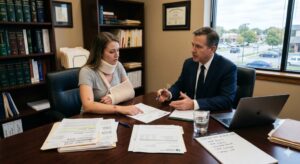
When injuries are serious or fault is disputed, attorney consultation isn’t optional. A PI attorney explains your rights under Kansas’s hybrid no-fault/tort system, manages communications with insurers and PIP claims, gathers and preserves evidence on a litigation timeline, and represents you in negotiation or court. Initial consultations are typically free, and Kansas’s two-year statute of limitations (K.S.A. § 60-513) makes early engagement essential — particularly for cases involving high medical costs, lost income, denied claims, or contested fault.
Carriers routinely push early settlements that don’t account for ongoing therapy, future treatment, lost earning capacity, or pain and suffering. Counsel reviews these offers against full damages and rejects what doesn’t reflect the case value. Most Overland Park PI firms — including Conduit Law — work on contingency: no upfront fee, no fee unless we recover. The structure removes the access barrier for claimants facing insurance carriers.
Recent Weather-Related Hazards and Community Initiatives
Kansas weather is a recurring crash factor. Winter storms produce ice on bridges and overpasses, low-visibility multi-vehicle pile-ups, and surface-friction failures within minutes of changing conditions. Wichita media has reported recurring icy-bridge pile-up patterns; similar dynamics affect Topeka, Manhattan, and the Kansas City metro. BikeWalk KC and similar advocacy groups push for infrastructure investments that protect pedestrians and cyclists year-round, particularly in underserved neighborhoods and school zones. The Wichita Eagle
Community-driven prevention programs are part of the response. Safety workshops, school-zone awareness campaigns, car-seat inspections, and DUI saturation enforcement bring local police, residents, and advocacy groups into a single conversation about prevention. Vision Zero’s multi-agency framework keeps long-term solutions visible while incorporating feedback from the people most affected by unsafe road conditions. The model’s effectiveness depends on follow-through — engineering, enforcement, and education all working together.
Conclusion
Recovering from a Kansas crash means working through the medical, financial, and legal layers in parallel. Knowing the state’s hybrid no-fault/tort framework, your own coverage stack, and when to call counsel is what protects both health and compensation. Conduit Law represents injured drivers, passengers, motorcyclists, and pedestrians across Overland Park and the broader Kansas City metro on contingency — no fee unless we recover. Free consultation; the deadlines run on the date of the crash.
References
[1] Abbott KC analysis of 2025 driving safety data (speeding + alcohol fatality metrics, KC ranking 6th) https://abbottkc.com/kansas-city-driving-safety-the-surprising-2025-ranking-you-need-to-know/
[2] Kansas Department of Transportation (KDOT). Kansas crash statistics and rural road safety data (CY2019–2023) https://kansashighwaypatrol.gov/ruralroads/
[3] Kansas Insurance Department. Personal Injury Protection (PIP) Coverage Requirements in Kansas (No-Fault Auto Insurance System). https://insurance.kansas.gov/auto-insurance/