

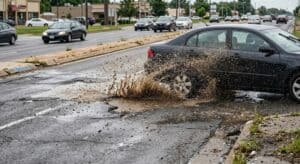
Most drivers treat rough pavement as an annoyance. You feel the jolt, mutter about the roads, and drive on. But uneven pavement does more than rattle your coffee. A deep pothole or a buckled stretch where one lane sits higher than the next can throw a car off line in an instant, and the trouble often lands on the driver who did nothing wrong. Learning how bad road surfaces turn into real crashes is the best way to spot the hazard before it reaches you.
How Uneven Pavement Turns Into a Crash
The danger usually starts with a loss of control. Hit a deep pothole at speed and the impact can blow a tire or knock the steering out of alignment, either of which can pull the car sideways before the driver reacts. A raised edge between two lanes, the kind left behind when a road is milled but not yet repaved, can grab a tire and drag the car toward the drop, especially when a driver tries to cross it while changing lanes. The faster you are going, the less of this you can undo. At highway speed, a blown tire from one hard pothole strike can send a car across several lanes before the driver has any real chance to correct it.
Then there is the swerve. Plenty of pavement crashes don’t happen because a car hits the bad spot. They happen because a driver spots a pothole at the last second and yanks the wheel to miss it, drifting into another lane or into oncoming traffic. Motorcyclists face the worst of it. A gap or ridge that a car shrugs off can put a rider on the ground, since two wheels leave far less room for error. Even a slow-speed encounter with broken pavement can end with a rider down in the middle of a lane.
Why These Hazards Catch Drivers Off Guard
Part of what makes uneven pavement so dangerous is that it hides. A pothole filled with rainwater looks like a harmless puddle until a wheel drops into it. At night, a shadow and a real dip look identical until it’s too late to slow down. Faded lane markings on a patched, mismatched surface make it harder to judge where the safe path even is. Drivers are expected to slow for conditions, but no amount of caution helps against a hazard you can’t see until you are already on top of it.
Work zones raise the risk further. Repaving a road often leaves temporary height differences between lanes or steel plates covering open cuts, and drivers depend on clear signs and markings to warn them. When those warnings are missing or set up wrong, a driver can roll into a hazard at full speed with no reason to expect it. Rural roads and older neighborhoods tend to be the worst, where thin budgets let repairs lag for years, though even busy highways grow dangerous edges during repaving. A few uneven-pavement dangers that catch people out include:
- Water-filled potholes that hide their true depth
- Lane edges left uneven after milling or partial repaving
- Steel road plates that shift or sit above the surface
- Frost heaves and buckling that appear overnight
Any of these can turn an ordinary drive into a sudden emergency, with little warning.
Who Is Responsible When Bad Roads Cause a Wreck
When a crash traces back to the road itself, the question of blame gets more complicated than a typical fender bender. Roads are maintained by government bodies, whether a city, a county, or a state agency, and those bodies have a duty to keep their surfaces reasonably safe and to warn drivers about known hazards. When they let a dangerous pothole sit unrepaired for months after complaints, they can share responsibility for a resulting crash.
Claims against a government agency come with their own hurdles, though. They often carry much shorter deadlines than an ordinary injury claim, sometimes only a few months, along with special notice rules and limits on how much you can recover. Miss one of those early steps and a valid claim can vanish before it begins. This is where a car accident lawyer earns their keep, because knowing which agency is responsible and how fast you must act can decide whether a case is possible at all. Waiting to see how you heal before looking into your options can quietly cost you the claim.
Government isn’t always the only party to look at. In a work zone, the contractor responsible for signs and safe conditions may be at fault if it left a hazard unmarked. Another driver who was speeding or following too closely can share the blame for how the crash actually unfolded. Untangling those threads takes evidence from the scene, and a good car accident lawyer like the attorneys at Thomas Law Offices moves fast to photograph the pavement and pull the repair records before the road gets patched and the proof disappears. It helps to treat the road as evidence yourself, too. If it’s safe, photograph the pothole and note the exact spot, then report it to the agency responsible, since that record can matter later.
The takeaway is simple even when the liability isn’t. Uneven pavement is a genuine hazard, not just a rough ride, and a crash caused by a road nobody bothered to fix is often someone’s legal responsibility. Slowing down over rough stretches protects you in the moment, and knowing that bad roads can be somebody’s fault protects you if the worst happens anyway.