

Understanding the Fundamentals of Personal Injury Law
Navigating the aftermath of an injury, particularly one caused by another’s negligence, often leads individuals into the realm of personal injury law. This legal field is designed to provide recourse for those who have suffered harm due to the wrongful acts or omissions of others. At its core, a personal injury claim hinges on the concept of negligence. Negligence occurs when an individual or entity fails to exercise the reasonable care that a prudent person would have exercised in a similar situation, resulting in injury to another.
To successfully pursue a personal injury claim, four key elements of negligence must typically be established:
- Duty of Care: The defendant owed a legal duty to the plaintiff to act in a certain way. For instance, drivers owe a duty of care to other road users, including cyclists, to operate their vehicles safely and follow traffic laws.
- Breach of Duty: The defendant failed to uphold that duty of care. This could manifest as distracted driving, speeding, or failing to yield the right of way.
- Causation: The defendant’s breach of duty directly caused the plaintiff’s injuries. There must be a clear link between the negligent act and the harm suffered.
- Damages: The plaintiff suffered actual, quantifiable harm as a result of the injuries. These can include medical expenses, lost wages, pain, and suffering.
Understanding these foundational principles is crucial for anyone considering legal action. For a deeper dive into these concepts, you can explore resources on the introduction to personal injury law.
In Pennsylvania, the concept of liability in personal injury cases is governed by “modified comparative negligence.” This legal doctrine is vital for cyclists to understand, as it can significantly affect their ability to recover damages if they are found partially at fault in an accident.
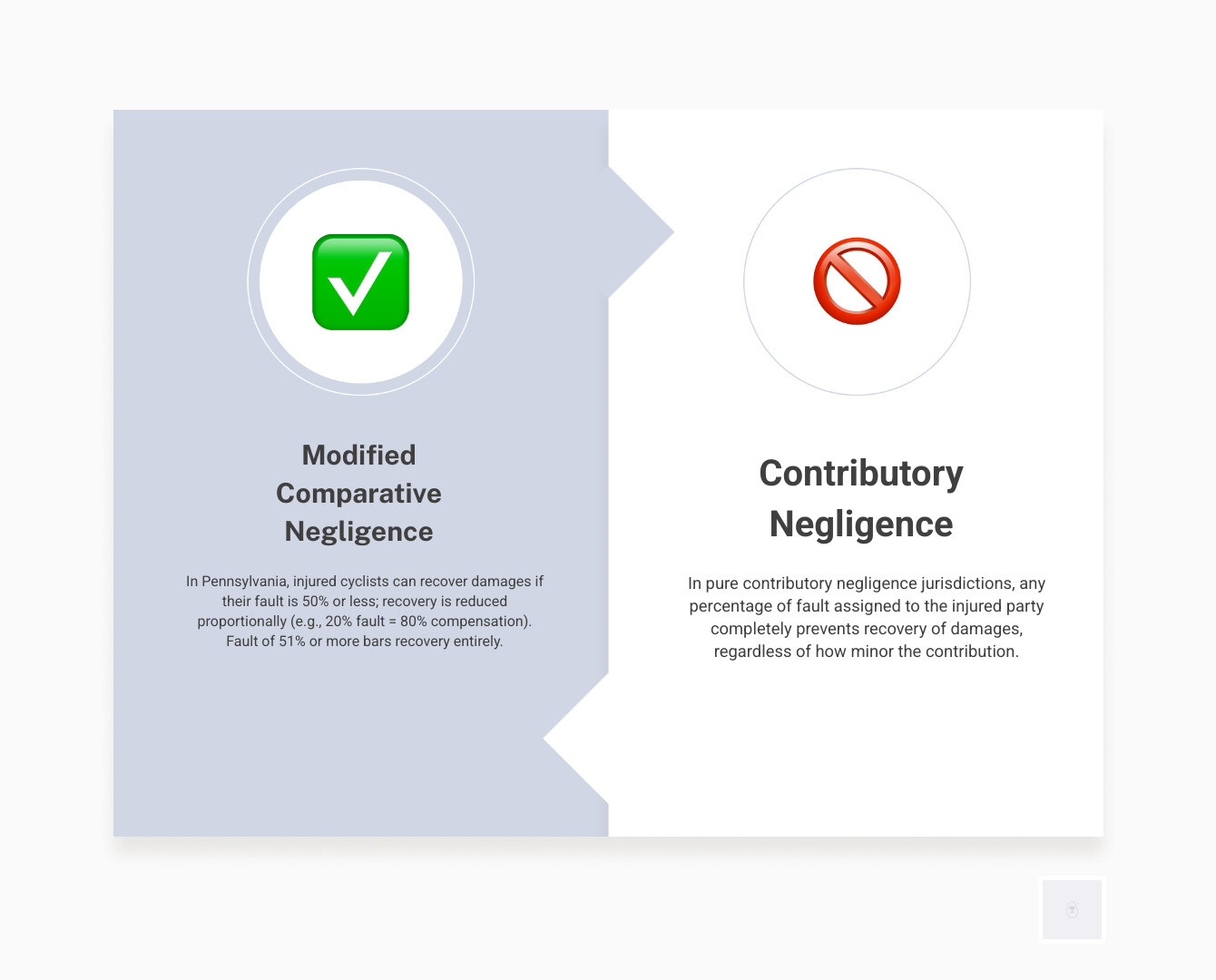
Under Pennsylvania’s modified comparative negligence rule, an injured party can still recover compensation even if they contributed to the accident, as long as their share of fault is less than 51%. If a cyclist is found to be 50% or less at fault, their recoverable damages will be reduced proportionally to their percentage of fault. For example, if a cyclist suffers $100,000 in damages but is found to be 20% at fault, they would only be able to recover $80,000. However, if the cyclist is found to be 51% or more at fault, they are barred from recovering any damages. This differs from “contributory negligence,” in which any fault on the part of the injured party would completely bar recovery.

This system underscores the importance of thorough investigation and skilled legal representation to minimize the risk of assigning fault to the injured cyclist. For more information on the nuances of personal injury law in the region, consider reviewing a comprehensive guide to personal injury law in Scranton.
Common Causes and Legal Implications of Bicycle Accidents in Pennsylvania
Bicycle accidents in Pennsylvania are a growing concern, with statistics revealing an upward trend. The number of bicycle accidents in Pennsylvania increased from 819 in 2020 to 1,271 in 2024, indicating a substantial rise. This increase underscores the persistent dangers cyclists face on the road. Nationally, preventable deaths from bicycle transportation incidents saw a 53% increase over the last ten years, reaching 1,377 fatalities in 2023. These figures highlight the critical need for vigilance and legal protection for injured cyclists.
Many factors contribute to these accidents, but driver behavior is frequently identified as a primary cause.
- Distracted Driving: Drivers who are distracted by their phones, navigation systems, or other activities often fail to notice cyclists, leading to collisions.
- Speeding: Excessive speed reduces a driver’s reaction time and increases the severity of impact in a crash.
- Dooring: This occurs when a vehicle occupant opens a door into the path of an oncoming cyclist without checking for traffic.
- Failure to Yield: Drivers often fail to yield to cyclists at intersections, during turns, or when changing lanes, violating a cyclist’s right-of-way.
- Road Defects: Poor road conditions, such as potholes, uneven pavement, or debris, can cause cyclists to lose control, sometimes forcing them into traffic.
- Insufficient Passing Space: Drivers failing to provide adequate clearance when passing cyclists is a common and dangerous issue.
Pennsylvania’s Vehicle Code (Title 75) outlines laws governing both motorists and cyclists to promote road safety. One crucial regulation is the 4-foot passing rule, which requires drivers to maintain a minimum distance of 4 feet when passing a bicycle. This exceeds the three-foot standard in many other states and reflects an acknowledgment of cyclists’ vulnerability. Cyclists, in turn, are generally afforded the same rights and responsibilities as drivers, meaning they must obey traffic signals, stop signs, and other road rules. However, they are also required to ride as far to the right as practicable, unless making a left turn, avoiding hazards, or passing another vehicle. Helmets are only legally required for cyclists under 12, but they are strongly recommended for all riders.

Despite these laws, infrastructure hazards continue to pose significant risks. Many urban and suburban areas lack dedicated, protected bike lanes, forcing cyclists to share roadways with fast-moving vehicular traffic. Advocacy groups often push for Vision Zero initiatives and physical barriers, such as concrete curbs rather than paint, to truly protect vulnerable road users. When these hazards contribute to an accident, the responsible parties—whether a negligent driver, a municipality that fails to maintain roads, or a property owner—can be held accountable. For those seeking justice after such incidents, understanding who to turn to for Experienced PA bicycle accident attorneys is paramount.
Proving Negligence in Personal Injury Law
Proving negligence in a bicycle accident lawsuit requires a meticulous approach to evidence collection and presentation. The success of a claim often hinges on the ability to reconstruct the crash and demonstrate that the defendant’s actions (or inaction) directly caused the cyclist’s injuries.
Key elements in proving negligence include:
- Police Reports: These official documents provide initial details of the accident, witness statements, and sometimes preliminary determinations of fault.
- Witness Statements: Eyewitness accounts can be invaluable, offering independent perspectives on how the accident occurred.
- Surveillance Footage: Traffic cameras, dash cams, or nearby business security cameras can capture critical visual evidence of the collision.
- Scene Photography: Detailed photos of the accident scene, vehicle damage, bicycle damage, road conditions, and any visible injuries are crucial for documentation.
- Crash Reconstruction: Experts in accident reconstruction can analyze physical evidence, vehicle data, and witness accounts to create a scientific explanation of the events leading to the crash.
- Expert Testimony: Beyond accident reconstructionists, medical professionals, economists, and vocational experts may provide testimony on the extent of injuries, future medical needs, and lost earning capacity.
- Forensic Analysis: In some cases, forensic analysis of vehicle components, bicycle parts, or road surfaces may be necessary.
- Evidence Preservation: Prompt action to secure all potential evidence is vital, as it can be lost or altered over time.
The burden of proof rests with the plaintiff to show, by a preponderance of the evidence, that the defendant’s negligence caused their injuries. This is why thorough preparation and a comprehensive understanding of the role of evidence in personal injury claims are so critical.
Vulnerable Road Users and Personal Injury Law
Cyclists and pedestrians are among the most vulnerable road users, lacking the physical protection afforded by a vehicle. This inherent vulnerability translates into a higher risk of severe injury or fatality in collisions with motor vehicles. In 2024, for instance, Philadelphia alone recorded 125 traffic crash fatalities, with 54 pedestrians and 3 cyclists among the victims. These sobering statistics underscore the urgent need for enhanced safety measures and robust legal protections.
The legal system recognizes this vulnerability, and personal injury law strives to protect the rights of cyclists and pedestrians. Advocacy efforts, such as the Vision Zero initiative, aim to eliminate traffic fatalities and severe injuries by improving road design, enforcing traffic laws, and promoting safer behaviors. For cyclists, this means advocating for protected bike lanes, improved intersection design, and public education campaigns for both drivers and riders.
When accidents occur, the legal framework allows injured vulnerable road users to seek compensation for their losses. This includes not only direct medical costs and lost wages but also intangible damages like pain and suffering. Legal professionals specializing in personal injury are often engaged in broader safety advocacy, understanding that safer streets reduce the incidence of preventable tragedies. They work to ensure that the legal process not only secures justice for their clients but also contributes to overall injury prevention and to the community’s legal empowerment.
Immediate Steps and Evidence Preservation After an Incident
The moments immediately following a bicycle accident in Pennsylvania can be chaotic and disorienting. Yet, the actions taken during this critical period can profoundly impact the success of any future legal claim. Knowing what to do and what to avoid is essential for safeguarding your health and your legal rights.
Here’s a step-by-step guide on what to do immediately after a bicycle accident:
- Ensure Safety and Seek Medical Attention: Your health is the top priority. Move yourself and your bicycle to a safe location if possible. Call 911 for emergency medical services, even if your injuries seem minor. Some serious injuries, like concussions or internal bleeding, may not be immediately apparent. A prompt medical evaluation creates an official record of your injuries.
- Call the Police: Report the accident to the police immediately. A police report documents the incident and can be crucial evidence. Obtain the police report number and the investigating officer’s contact information.
- Do Not Admit Fault: Avoid making any statements that could be construed as admitting fault, even if you’re unsure who was to blame. Stick to the facts when speaking with police or other parties involved.
- Exchange Information: Collect contact and insurance information from all parties involved, including drivers, passengers, and witnesses. Get names, phone numbers, addresses, vehicle license plate numbers, and insurance policy details.
- Document the Scene: If physically able, use your smartphone to take extensive photos and videos of the accident scene. This includes:
- Damage to your bicycle and any vehicles involved.
- Your injuries (bruises, cuts, road rash).
- The position of vehicles and your bicycle.
- Road conditions (potholes, debris, skid marks).
- Traffic signs, signals, and any relevant landmarks.
- Weather conditions.
- Identify Witnesses: Ask bystanders if they witnessed the accident and obtain their contact information. Their testimony can be invaluable.
- Avoid Speaking with Insurance Companies (Initially): Do not give a recorded statement to the at-fault driver’s insurance company without first consulting with an attorney. Insurers may try to minimize your claim or trick you into saying something that could harm your case.
- Preserve Evidence: Keep your damaged bicycle, helmet, and any clothing worn during the accident. Do not repair or discard them, as they can serve as crucial physical evidence.
- Keep a Detailed Record: Start a journal documenting your injuries, pain levels, medical treatments, medications, lost workdays, and how the accident has impacted your daily life. Keep all medical bills, receipts, and correspondence related to the accident.

Following these steps can significantly strengthen your personal injury claim. For more detailed guidance on the dos and don’ts after a personal injury in Northeastern PA, consulting with legal professionals is highly recommended. Understanding the legal process in personal injury cases from the outset can alleviate much of the stress involved.
Navigating the Workers’ Compensation System in Pennsylvania
While many bicycle accidents occur during recreational rides or commutes, some cyclists are injured while performing work-related duties. In such cases, the Pennsylvania workers’ compensation system may come into play, offering a different avenue for recovery alongside, or sometimes instead of, a traditional personal injury claim.
Pennsylvania’s workers’ compensation system is generally a “no-fault” system. This means that if you are injured while working, you are typically entitled to benefits regardless of who was at fault for the accident, as long as the injury occurred within the scope of your employment. This can be particularly beneficial for cyclists who might otherwise face challenges proving negligence in a third-party claim or dealing with comparative negligence issues.
Key aspects of navigating workers’ compensation for a work-related bicycle accident include:
- Reporting Requirements: It is crucial to report your injury to your employer as soon as possible, ideally within 21 days, though the absolute deadline is 120 days. Failure to report promptly can jeopardize your claim.
- Medical Treatment: Your employer’s insurance company may direct you to specific doctors for an initial period. Following their medical advice and attending all appointments is critical for your claim.
- Evidence Gathering: While fault is not a primary concern, documenting the accident, your injuries, and the work-related nature of the ride remains important. This includes witness statements, police reports (if applicable), and any communications related to your work duties at the time of the accident.
- Employment Records: Maintaining accurate records of your work schedule, job duties, and any lost wages due to the injury will be essential for calculating benefits.
- Filing Procedures: The process involves specific forms and deadlines that must be adhered to. Missing a deadline can result in the forfeiture of your rights.
- Wage Loss Benefits: If your injuries prevent you from working, workers’ compensation can provide partial wage replacement.
- Medical Expense Coverage: All reasonable and necessary medical expenses related to your work injury should be covered.
Navigating the complexities of both personal injury and workers’ compensation law simultaneously can be challenging. An experienced workers’ compensation lawyer can help determine the best course of action, ensuring that all potential avenues for compensation are explored and pursued effectively. For a broader understanding of various claims, exploring common types of personal injury cases in Scranton can also be insightful.
Calculating Damages and Understanding the Statute of Limitations
When a bicycle accident results in injuries, calculating the full extent of damages is a critical step in securing fair compensation. Damages in personal injury cases are generally categorized into economic and non-economic damages, with punitive damages awarded in rare circumstances.
Economic Damages are quantifiable financial losses directly resulting from the accident. These can include:
- Medical Expenses: Past and future costs for hospital stays, doctor visits, surgeries, medications, physical therapy, rehabilitation, and assistive devices.
- Lost Wages: Income lost due to time off work for recovery, appointments, or disability.
- Loss of Earning Capacity: Compensation for the reduction in your ability to earn income in the future due to permanent injuries or disability.
- Property Damage: Costs associated with repairing or replacing your damaged bicycle, helmet, and other personal property.
Non-Economic Damages are subjective losses that lack a direct monetary value but significantly impact the injured person’s quality of life. These include:
- Pain and Suffering: Physical pain and emotional distress caused by the injuries.
- Emotional Trauma: Psychological impacts such as anxiety, depression, PTSD, or fear of cycling.
- Loss of Consortium: Compensation for the negative impact on marital relationships due to the injury.
- Loss of Enjoyment of Life: Damages for the inability to participate in hobbies, activities, or daily routines that were once enjoyed.
Punitive Damages are rarely awarded in personal injury cases. They are not intended to compensate the victim but rather to punish the defendant for exceptionally reckless, malicious, or egregious conduct and to deter similar behavior in the future.
Understanding the full scope of potential compensation is essential for maximizing your recovery. For a more in-depth look, consider resources on understanding compensation in personal injury cases and maximizing your personal injury compensation in Scranton.
The Statute of Limitations
Another crucial legal concept is the statute of limitations, which sets a strict deadline for filing a lawsuit. In Pennsylvania, the statute of limitations for most personal injury claims, including bicycle accidents, is two years from the date of the injury. If a lawsuit is not filed within this two-year window, the injured party generally loses their right to pursue compensation through the courts, regardless of the merits of their case.
There are limited exceptions to this rule, such as the “discovery rule,” which may extend the deadline if the injury or its cause was not immediately discoverable. However, these exceptions are complex and require careful legal analysis. It is imperative to consult with an attorney as soon as possible after an accident to ensure that all deadlines are met. For more details, refer to information on understanding the statute of limitations for personal injury cases in Scranton.
The Role of Specialized Expertise in Personal Injury Law
The complexities of bicycle accident claims, from proving negligence and calculating damages to navigating insurance company tactics and adhering to legal deadlines, underscore the critical importance of specialized legal expertise. While any personal injury attorney can handle a car accident, a lawyer with specific experience in bicycle accidents offers distinct advantages.
Attorneys who are also cyclists themselves often bring a unique understanding of crash mechanics, road dangers, and the specific challenges faced by riders. They understand the nuances of cycling culture, common types of collisions (such as “dooring” and “right hooks”), and how infrastructure design affects safety. This personal insight can be invaluable in:
- Investigating the Accident: They know what evidence to look for, from tire marks and road debris to the specific angles of impact that reveal liability.
- Communicating with Experts: They can effectively collaborate with accident reconstructionists, biomechanical engineers, and medical professionals, speaking their language to build a robust case.
- Negotiating with Insurance Companies: Insurance adjusters often recognize and respect firms with authentic cycling credentials, which can lead to more favorable settlement negotiations. They understand that such firms are prepared for trial and possess deep knowledge of the specifics of bike crashes.
- Trial Preparation: Should the case go to trial, an attorney with specific cycling knowledge can more effectively convey the reality of a cyclist’s experience to a jury, humanizing the victim and clarifying technical details.
Beyond cycling-specific knowledge, specialized personal injury attorneys are adept at managing all aspects of a claim, including:
- Medical Documentation: Ensuring all injuries, from road rash and broken bones to spinal cord and brain injuries, are thoroughly documented and linked to the accident.
- Settlement Valuation: Accurately assessing the full value of a claim, including future medical costs and lost earning potential.
- Litigation Strategy: Developing a comprehensive plan to pursue justice, whether through negotiation, mediation, or courtroom litigation.
Choosing a legal team that understands the unique aspects of bicycle accidents, and indeed, all types of personal injury claims, can make a significant difference in the outcome of your case. For individuals seeking a personal injury attorney in Scranton and Wilkes-Barre, PA, this specialized knowledge is a key differentiator.
Frequently Asked Questions about Pennsylvania Injury Claims
Here, we address common questions individuals have about personal injury claims, particularly those involving bicycle accidents in Pennsylvania.
What is the statute of limitations for filing a bicycle accident claim in PA?
As of May 2026, the general statute of limitations for filing a personal injury lawsuit, including those stemming from bicycle accidents, in Pennsylvania is two years from the date of the accident. This means that legal action must be initiated within two years, or the right to pursue compensation through the courts may be forfeited. There are very limited exceptions, such as the “discovery rule” for injuries not immediately apparent, or cases involving minors. However, relying on these exceptions can be risky, so prompt legal consultation is always advised. For specific details about your situation, it’s best to consult an injury lawyer in Scranton or the surrounding area.
How do insurance companies handle bicycle accident claims in Pennsylvania?
Insurance companies handle bicycle accident claims with the intention of minimizing payouts. They often employ various tactics to achieve this:
- Questioning Liability: Insurers may attempt to shift blame to the cyclist, leveraging Pennsylvania’s modified comparative negligence rule to reduce or deny a claim.
- Minimizing Injuries: They might argue that injuries are pre-existing, not severe, or not directly caused by the accident.
- Lowball Settlement Offers: Early settlement offers are often significantly lower than the true value of a claim, hoping the injured party will accept quickly out of financial pressure.
- Requesting Recorded Statements: They may ask for a recorded statement, which can later be used against the claimant if inconsistencies are found or if the claimant inadvertently admits fault.
Given these tactics, it is highly recommended that injured cyclists avoid negotiating directly with the at-fault driver’s insurance company without legal representation. An experienced personal injury attorney understands these strategies and can protect your rights, handle all communications, and negotiate for fair compensation. To avoid pitfalls during the personal injury claim process, seeking legal counsel is crucial.
Why is it important to hire a bicycle accident attorney who is also a cyclist?
Hiring a bicycle accident attorney who is also a cyclist offers a significant advantage, given their unique perspective and understanding. Such an attorney possesses:
- Firsthand Knowledge: They understand the mechanics of cycling, the common types of accidents, and the specific hazards cyclists face on Pennsylvania roads. This personal experience enables them to visualize the accident more clearly, anticipate defense arguments, and convey the cyclist’s experience to a jury.
- Credibility: Their personal involvement in cycling lends authenticity to their representation. Insurance adjusters and judges often recognize this specialized knowledge, which can influence negotiations and court proceedings.
- Empathy and Advocacy: They genuinely empathize with the client’s experience and injuries, often having faced similar risks themselves. This deep understanding fuels a passionate and effective advocacy, ensuring all aspects of the client’s suffering and loss are considered.
- Network and Resources: They often have connections within the cycling community, including experts in bike mechanics, accident reconstruction, and local advocacy groups, which can be invaluable for building a strong case.
This specialized insight goes beyond general personal injury law, offering a nuanced approach to bicycle accident claims that can significantly impact outcomes. When considering when to consult a personal injury attorney, particularly after a bicycle accident, the value of a cycling-savvy lawyer cannot be overstated.
Conclusion
Navigating the aftermath of a personal injury, especially a bicycle accident in Pennsylvania, can be a daunting journey filled with legal complexities, medical challenges, and financial strain. From understanding the fundamental principles of negligence and Pennsylvania’s unique comparative negligence laws to meticulously preserving evidence and dealing with insurance companies, each step requires careful consideration and informed decision-making.
As of May 2026, the landscape for cyclists continues to evolve, with increasing accident rates highlighting the ongoing need for both improved safety measures and robust legal protections. For those who have suffered harm due to another’s negligence, pursuing a personal injury claim is not merely about compensation; it is about seeking justice, accountability, and the resources necessary for recovery and long-term stability.
The guidance of experienced legal counsel, particularly attorneys with specialized knowledge in bicycle accidents, can be invaluable. Their expertise can help demystify the legal process, protect your rights, and work tirelessly to secure the compensation you deserve. If you or a loved one has been injured, do not hesitate to seek professional representation. A timely case evaluation can be the first crucial step toward recovery and justice.