

Understanding Michigan No-Fault Insurance and How It Works
At its core, Michigan’s no-fault insurance system is designed to provide rapid compensation for injuries and damages after a car accident, regardless of who caused it. This means that if you’re involved in a crash, your own insurance company typically pays for your medical expenses and other related losses, rather than waiting for fault to be determined. This system aims to reduce litigation and ensure that accident victims receive necessary care promptly.
The legal foundation for this system is enshrined in Michigan Compiled Laws (MCL) Section 500.3101, which mandates that all vehicle owners maintain specific types of insurance coverage. This “security for payment of benefits” is required only when your vehicle is driven or moved on a highway. While a standard insurance policy is the most common method, alternative security methods can be approved by the Secretary of State.
Michigan no-fault insurance comprises three mandatory components:
- Personal Injury Protection (PIP): This is arguably the most crucial part of Michigan’s no-fault system. PIP covers reasonable and necessary medical expenses, up to three years of lost wages (at 85% of gross income, up to a monthly maximum, which was $5,700 as of October 2018), and replacement services (up to $20 per day for up to three years) for household tasks you can no longer perform. It also includes survivor’s loss benefits if an accident results in death. PIP benefits extend to the named insured, their spouse, and resident relatives, whether they are in a car, a passenger in another vehicle, or even a pedestrian or bicyclist involved in a car accident. PIP covers accidents that occur in the U.S. and Canada.
- Property Protection Insurance (PPI): This coverage pays for damage your vehicle causes to other people’s property in Michigan, up to a limit of $1 million. This includes damage to buildings, fences, utility poles, and even other properly parked vehicles. Importantly, PPI does not cover damage to moving vehicles or accidents that occur outside of Michigan.
- Residual Liability Insurance (Bodily Injury and Property Damage): While Michigan is a no-fault state for personal injuries, fault still matters for serious injuries and property damage to other vehicles. Residual liability coverage protects you if you are at fault for an accident that causes severe injuries or death to others, or property damage outside of Michigan. It also covers noneconomic damages (like pain and suffering) if the injured party meets a specific threshold.
Here’s a comparison of the mandatory coverages and their minimum limits:
| Coverage Type | Purpose ###
The 2019-2020 Reforms and PIP Medical Coverage Options
The landscape of Michigan no-fault insurance underwent significant changes with the reforms enacted in 2019, with most provisions taking effect on July 1, 2020. These reforms were primarily aimed at reducing the state’s historically high auto insurance premiums by introducing choices for Personal Injury Protection (PIP) medical coverage, which was previously unlimited and mandatory for all drivers.
PIP Medical Coverage Options: Under the new law, drivers can now select from several tiers of PIP medical coverage, allowing them to tailor their policies to their individual needs and existing health insurance:
- Unlimited PIP Medical Coverage: This option provides the same comprehensive, lifetime medical benefits as before the reforms. While it generally comes with the highest premium, it offers the most extensive protection.
- $500,000 PIP Medical Coverage: A substantial cap for medical expenses, suitable for those who want significant coverage but may not need unlimited.
- $250,000 PIP Medical Coverage: A mid-tier option providing a considerable level of medical protection.
- $50,000 PIP Medical Coverage (for Medicaid recipients): This option is available to drivers who are enrolled in Medicaid.
- PIP Medical Opt-Out (for those with Qualified Health Coverage – QHC): Drivers can completely opt out of PIP medical coverage if they have Qualified Health Coverage (QHC) that will cover auto accident injuries and has an individual deductible of $6,579 or less (for policies issued or renewed after July 1, 2020). This QHC can be Medicare Parts A and B (or a Medicare Advantage plan) or a private health insurance policy. If you opt out and later lose your QHC, you have a strict 30-day window to notify your insurer and obtain PIP coverage, or you risk losing all PIP medical benefits.
- PIP Medical Opt-Out (for Medicare recipients): If you have Medicare Parts A and B, you can opt out of PIP medical coverage entirely, relying on Medicare as your primary payer for auto accident-related medical care. This was a significant shift, as historically Medicare always paid last in Michigan due to the mandatory unlimited PIP.
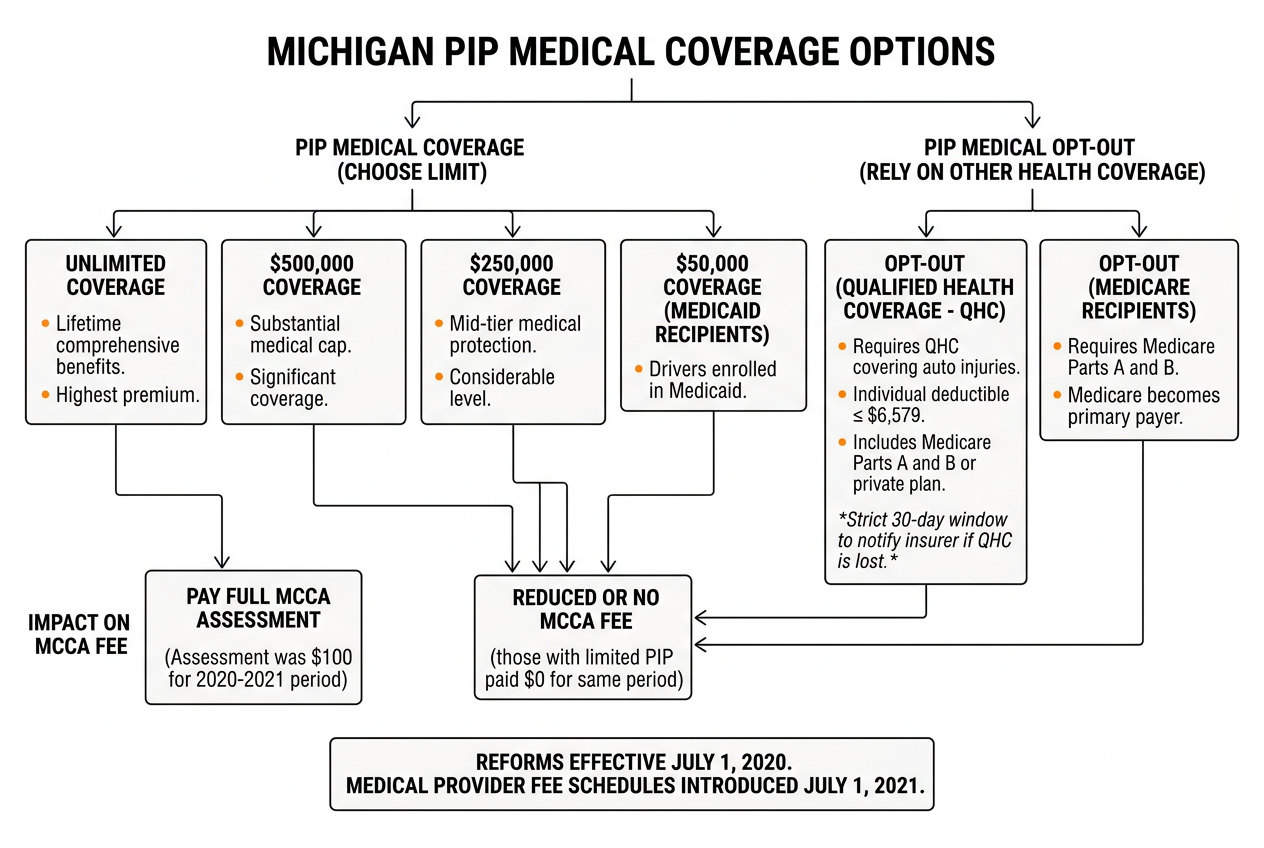
These choices have a direct impact on the Michigan Catastrophic Claims Association (MCCA) fee. Drivers who choose unlimited PIP medical coverage still pay an MCCA assessment, which funds the reimbursement of insurers for PIP claims exceeding a certain threshold (currently $635,000). However, those who select limited PIP options or opt out entirely pay a reduced or no MCCA fee, contributing to potential premium savings. For example, for the period of July 2, 2020, through June 30, 2021, the MCCA assessment for unlimited PIP was $100 per vehicle, while those with limited PIP paid $0.
Beyond coverage limits, the reforms also introduced:
- Fee Schedules for Medical Providers: Effective July 1, 2021, a fee schedule was implemented, capping what medical providers can charge for services related to auto accident injuries. This schedule generally limits reimbursement to a percentage of Medicare rates (e.g., 200% initially, declining to 190% thereafter) or a percentage of what providers charged in 2019 for non-Medicare services (e.g., 55% initially, declining to 52.5% thereafter). This has been a contentious change, with some describing the non-Medicare fee schedule as “draconian” and potentially impacting provider availability.
- Attendant Care Limits: For accidents occurring after July 1, 2020, there’s a significant change regarding attendant care provided by family members. Insurers are now only required to pay for up to 56 hours per week of in-home attendant care provided by family members or household associates. This limit does not apply to care provided by commercial agencies. This change has had a profound impact on catastrophically injured individuals and their families.
These reforms mean that Michigan drivers now have more control over their insurance costs, but also bear more responsibility in understanding their coverage choices and potential financial exposure. Navigating these new rules, especially when dealing with claim denials or disputes, can be complex. For those facing such challenges, understanding your legal options and potentially seeking legal assistance can be crucial in Fighting Michigan no-fault claim denials and ensuring you receive the benefits you are entitled to.
Navigating Claims, Shared Fault, and Third-Party Lawsuits
Understanding how claims are processed under Michigan’s no-fault system is vital for all drivers. When an accident occurs, the process typically involves two distinct types of claims: first-party claims and third-party lawsuits.
First-Party Claims (No-Fault Benefits): As a no-fault state, your initial recourse for injuries and certain economic losses is to file a first-party claim with your own insurance company. This means your insurer will pay for your PIP benefits—medical expenses, lost wages, and replacement services—regardless of who was at fault for the accident. The application for no-fault benefits must generally be filed within one year of the accident date. There are also specific rules, often referred to as the “one-year back rule,” which limit recovery to expenses and losses incurred within one year prior to the date the claim is filed or suit is commenced.
Shared Fault (Comparative Negligence): Even though Michigan is a no-fault state for personal injury benefits, fault still plays a role, particularly in third-party lawsuits and property damage claims. Michigan follows a system of modified comparative negligence. This means that if you are partially at fault for an accident, you can still recover damages from the other driver, but your compensation will be reduced by your percentage of fault. For example, if you are found 20% at fault, your recoverable damages will be reduced by 20%. However, if you are found to be more than 50% at fault (the “51% bar”), you generally cannot recover noneconomic damages (like pain and suffering) from the other driver, though your no-fault benefits from your own insurer remain unaffected.
Third-Party Lawsuits (Tort Claims): While the no-fault system aims to limit lawsuits, there are specific circumstances under which you can sue the at-fault driver (a “third-party lawsuit”). These lawsuits are typically for:
- Noneconomic Damages: To sue for pain and suffering, emotional distress, and other noneconomic losses, you must demonstrate that you have suffered a “serious impairment of body function,” permanent serious disfigurement, or death. A serious impairment of body function is defined as an objectively manifested impairment of an important body function that affects your general ability to lead your normal life. This threshold is often a point of contention and requires strong medical documentation and legal argument.
- Excess Economic Loss: If your economic losses (like lost wages) exceed the limits of your no-fault PIP coverage, you may be able to sue the at-fault driver for these “excess” amounts.
- Property Damage (Mini-Tort): For damage to your vehicle, Michigan has a “mini-tort” provision. This allows you to recover up to $3,000 (for accidents occurring after July 1, 2020) from the at-fault driver for vehicle damage not covered by your own collision insurance, or for your deductible.
What to Do Immediately After a Car Accident in Michigan: To protect your rights and facilitate any future claims, it’s crucial to take specific steps:
- Ensure Safety: Move to a safe location if possible, and check for injuries.
- Contact Authorities: Call 911 if anyone is injured or if there’s significant property damage. A police report is vital for insurance claims.
- Exchange Information: Collect names, contact information, insurance details, and license plate numbers from all drivers involved.
- Document the Scene: Take photos of vehicle damage, the accident scene, road conditions, and any visible injuries.
- Seek Medical Attention: Even if you feel fine, get checked by a medical professional. Some injuries may not be immediately apparent.
- Notify Your Insurer: Report the accident to your own insurance company as soon as possible. Delay can jeopardize your claim.
- Do Not Admit Fault: Avoid making statements that could be construed as admitting fault at the scene.
The statute of limitations for filing a third-party lawsuit for personal injury is generally three years from the date of the accident. However, as mentioned, no-fault benefits have a one-year statute of limitations. These deadlines are strict, and missing them can result in losing your right to compensation.
Essential Optional Coverages and Special Claims Programs
While Michigan’s no-fault law mandates certain coverages, prudent drivers should consider adding optional coverages to their policy for more comprehensive protection.
Optional Coverages to Consider:
- Collision Coverage: This pays for damage to your own vehicle if you are involved in a collision, regardless of fault. It’s especially important if you have a newer vehicle or a loan/lease, as it protects your investment.
- Comprehensive Coverage: This covers damage to your vehicle from non-collision events, such as theft, vandalism, fire, falling objects, or hitting an animal.
- Uninsured/Underinsured Motorist (UM/UIM) Coverage: Despite mandatory insurance laws, some drivers still operate without adequate coverage.
- Uninsured Motorist (UM) coverage protects you if you’re hit by a driver who has no auto insurance.
- Underinsured Motorist (UIM) coverage kicks in if the at-fault driver’s liability limits are not enough to cover your damages, particularly for noneconomic losses or excess economic losses that exceed your PIP benefits. Given that the minimum residual liability limits can be as low as $50,000 per person / $100,000 per accident (though the default is higher), UIM coverage can be crucial.
- Towing and Rental Car Coverage: These options cover the cost of towing your damaged vehicle and providing a rental car while yours is being repaired.
Michigan Assigned Claims Plan (MACP): What happens if you’re injured in an accident and don’t have your own auto insurance, or if the at-fault vehicle is uninsured and no other insurance policy applies? This is where the Michigan Assigned Claims Plan (MACP) comes into play. The MACP is a safety net designed to ensure that accident victims who meet specific criteria can still receive essential no-fault benefits.
Who Qualifies for MACP? You may qualify for benefits through the MACP if:
- You were injured in a motor vehicle accident in Michigan.
- You do not have your own auto insurance policy.
- You are not covered under another household member’s policy.
- No other auto insurance policy is applicable (e.g., the at-fault driver is uninsured, and you don’t have UM coverage).
- You are not disqualified from receiving benefits (e.g., by driving your own uninsured vehicle).
The MACP provides medical benefits, lost wages, and replacement services, similar to standard PIP, though medical benefits for uninsured non-occupants were capped at $250,000 after June 11, 2019.
Commercial Truck Accidents: While the core no-fault principles apply, commercial truck accidents often involve additional layers of complexity due to federal regulations and higher liability insurance requirements. Commercial trucks typically carry liability coverage ranging from $750,000 to $5,000,000, depending on their cargo. The sheer size and weight of these vehicles (a fully loaded semi can weigh up to 80,000 pounds compared to a car’s 4,000 pounds) often result in catastrophic injuries that quickly exceed personal auto insurance limits, making the pursuit of third-party claims against the trucking company and its insurer critical.
Named Driver Exclusions: Michigan law allows insurers to exclude specific drivers from coverage under certain circumstances. This is a critical provision detailed in official regulatory guidance, such as Bulletin 2015-19-INS from the Michigan Department of Insurance and Financial Services (DIFS). If a driver is formally “named excluded” on a policy, they are generally ineligible for PIP benefits if they are operating the insured vehicle at the time of an accident. Furthermore, if an excluded driver operates the vehicle, there is no residual liability insurance, and the vehicle is considered uninsured, potentially exposing the owner and operator to significant personal liability. The exclusion must be authorized by the insured and cannot be used to exclude an entire class of drivers.

When selecting your coverage, it’s important to review your policy document carefully to understand all options and limitations.
Frequently Asked Questions About Fighting Michigan No-Fault
We often encounter common questions and challenges when helping drivers navigate Michigan’s no-fault system. Here, we address some of the most pressing concerns.
What are the consequences of driving without insurance and how does it affect fighting Michigan no-fault claims?
Driving without insurance in Michigan carries severe penalties. It’s classified as a misdemeanor, punishable by a fine of up to $500, up to one year in jail, and a possible 30-day suspension of your driver’s license. Beyond these legal repercussions, driving uninsured has profound implications for your ability to receive benefits after an accident.
If you are found to be driving your own uninsured vehicle at the time of an accident, you are generally disqualified from receiving any no-fault PIP benefits, including medical expenses, lost wages, and replacement services. This means you would be personally responsible for all your accident-related medical bills and lost income. Furthermore, you would lose the immunity from tort lawsuits that no-fault provides, meaning you could be personally sued by others involved in the accident for their injuries and damages, potentially leading to significant financial ruin. This makes the ability to fight Michigan no-fault claims or denials incredibly difficult, as your fundamental right to benefits is forfeited.
Can family members be paid for attendant care when fighting Michigan no-fault insurers?
Yes, family members can be paid for providing attendant care (in-home nursing and assistance services) under Michigan no-fault insurance. However, the 2019 reforms introduced significant changes to this benefit, particularly for accidents occurring after July 1, 2020.
For these post-reform accidents, insurers are only required to pay for up to 56 hours per week of attendant care provided by family members or household associates. This cap does not apply if the care is provided by a commercial agency.
When fighting Michigan no-fault insurers over attendant care, proper documentation is paramount. You must meticulously record the type of care provided, the hours spent, and the dates of service. Insurers often dispute the medical necessity or the hourly rate of family-provided care. If a family member is providing care, it’s advisable to have a doctor’s prescription detailing the need for such care and the recommended hours. Rate disputes can arise, and while insurers may try to pay less than what a commercial agency would charge, legal precedent and strong advocacy can help ensure fair compensation.
How do coordinated vs. uncoordinated no-fault benefits differ?
When purchasing your no-fault policy, you often have a choice between “coordinated” and “uncoordinated” PIP benefits. This decision determines how your auto insurance interacts with any other health insurance you may have (e.g., through your employer or a private plan).
- Uncoordinated Benefits (Primary): If you choose uncoordinated benefits, your auto insurance policy acts as the primary payer for your accident-related medical expenses. This means your auto insurer pays first, up to your selected PIP medical limit, before your health insurance is involved. This option generally comes with a higher premium because your auto insurer bears the initial and full burden of medical costs. A key advantage is that you typically have more flexibility in choosing your medical providers, as you’re not restricted by your health insurance network. Deductibles from your health insurance typically do not apply to your auto insurance claim if it’s primary.
- Coordinated Benefits (Secondary): With coordinated benefits, your auto insurance policy acts as the secondary payer. Your health insurance policy becomes the primary payer for your accident-related medical expenses. Your auto insurer will only pay for costs that your health insurance doesn’t cover, such as deductibles, co-pays, or services not included in your health plan, up to your selected PIP medical limit. This option usually results in a lower auto insurance premium because your auto insurer’s exposure is reduced. However, you must be mindful of your health insurance’s deductibles and co-pays, as these would apply to your accident-related medical care. You would also be limited to your health insurance’s network of providers.
The choice between coordinated and uncoordinated benefits depends on your existing health coverage, its deductibles, and your willingness to pay a higher auto insurance premium for greater flexibility. When battling Michigan no-fault denials, the coordination of benefits can become a critical point of dispute, as insurers may try to shift responsibility to the other payer. Understanding your policy’s coordination language is essential.
Conclusion
Michigan’s no-fault auto insurance system, particularly after the transformative 2019-2020 reforms, is undeniably complex. From understanding mandatory coverages like PIP, PPI, and residual liability to navigating the diverse PIP medical options, fee schedules, and attendant care limits, there’s a lot for drivers to consider. We’ve explored how claims are processed, the role of shared fault, and the specific conditions under which third-party lawsuits can be pursued for noneconomic damages or excess economic losses.
Furthermore, we’ve highlighted the importance of optional coverages such as collision, comprehensive, and uninsured/underinsured motorist protection, and shed light on crucial programs like the Michigan Assigned Claims Plan. The severe consequences of driving without insurance and the intricacies of family-provided attendant care and coordinated benefits underscore the need for informed decision-making.
The goal of this guide has been to demystify these complexities, providing you with a clear understanding of your rights and responsibilities. As a Michigan driver, it’s crucial to:
- Review your policy regularly: Ensure your coverage aligns with your current needs and financial situation, especially given the new PIP medical choices.
- Understand your legal rights: Know when you can pursue a claim, the relevant statutes of limitations, and when legal counsel might be beneficial.
- Document everything: After an accident, meticulous record-keeping of medical treatments, lost wages, and attendant care is vital for any claim.
By being well-informed, you can make the best choices for your protection on Michigan’s roads and confidently navigate its unique no-fault insurance landscape.
