

Understanding Strict Liability and Negligence in Personal Injury Law
 A sudden dog attack can be a terrifying and life-altering event. Beyond the immediate shock, victims often face severe physical injuries, lasting emotional trauma, and significant financial burdens. These can include extensive medical bills, lost wages, and the need for long-term care.
When such an incident occurs, understanding your legal rights is crucial. Personal injury law offers a path for victims to seek justice and recover compensation for their losses. This guide is designed to help you navigate the complexities of canine attack claims.
We will explore key aspects of the legal process. This includes how liability is determined and the types of damages you can claim. Our goal is to empower you with the knowledge needed to protect your interests and pursue a fair resolution. This information is vital for protecting dog attack victims and ensuring they receive the support they deserve.
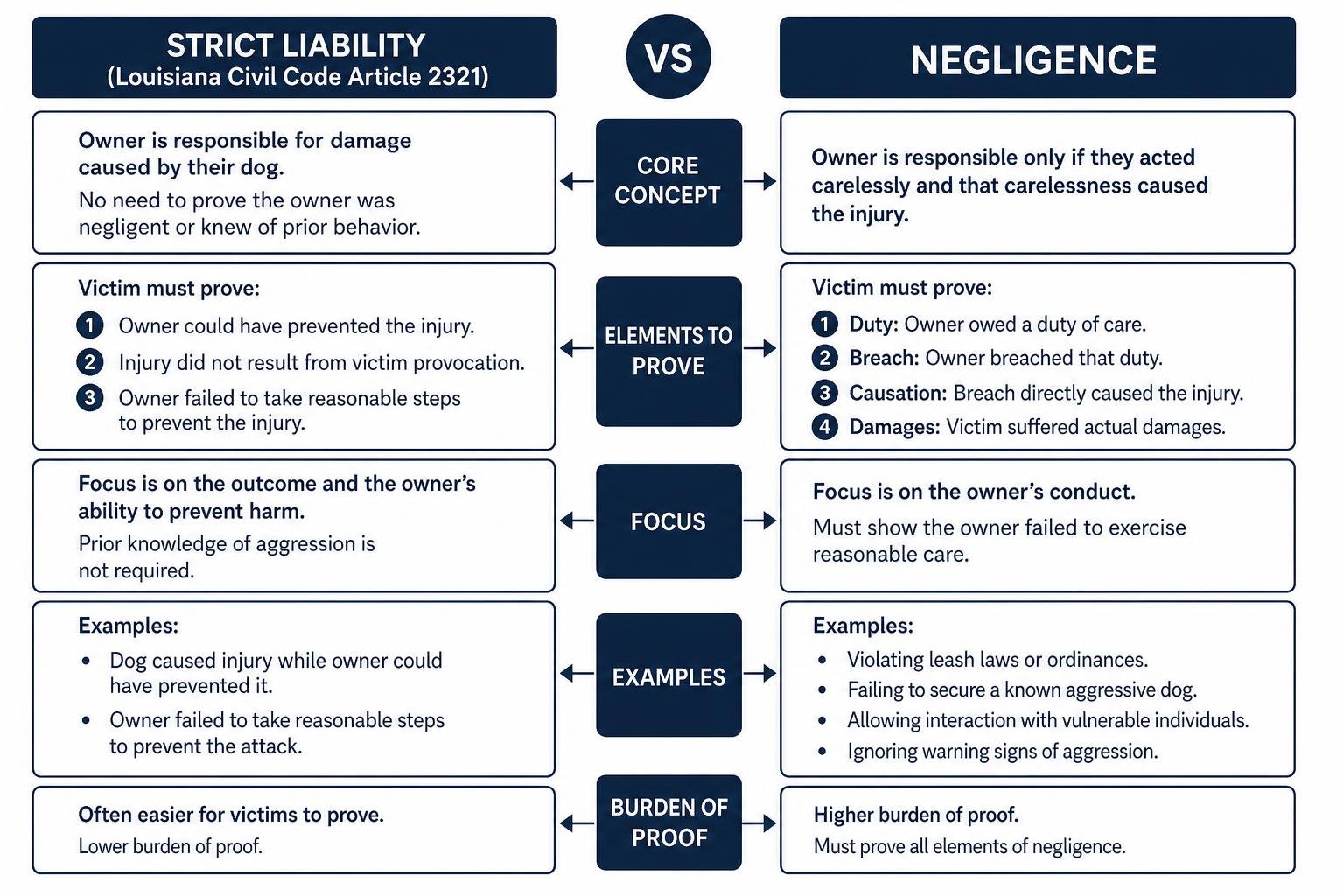
When addressing personal injury claims stemming from a canine attack, understand the legal frameworks that govern liability. In many jurisdictions, including Louisiana, two primary doctrines apply: strict liability and negligence. These doctrines determine how a dog owner can be held responsible for injuries caused by their animal.
Strict liability means that a party can be held liable for damages even if they did not act negligently or were not at fault. In the context of dog bites, a strict liability law typically holds the dog owner responsible for any injury caused by their dog, regardless of whether the owner knew the dog had a propensity to bite or acted carelessly. This approach simplifies the victim’s burden of proof, as they generally do not need to demonstrate that the owner was negligent. Instead, they primarily need to prove that the dog caused the injury and that they were lawfully present at the scene of the attack.
Louisiana’s legal framework, particularly under Louisiana Civil Code Article 2321, imposes strict liability on animal owners. This article states that “The owner of an animal is answerable for the damage caused by the animal.” However, it also includes important nuances. For a dog owner to be held liable for damages caused by their dog, the victim must prove several key elements:
This interpretation means that while Louisiana isn’t a “one-bite rule” state (where an owner is only liable if they knew their dog had bitten before), it also isn’t a pure strict liability state in the sense that the owner’s ability to prevent the harm is a factor. This blends elements of strict liability with a consideration of the owner’s actions.
On the other hand, negligence standards require the injured party to prove that the dog owner acted carelessly or failed to exercise reasonable care, and that this failure directly caused the attack. Examples of negligence might include allowing a dog to roam freely in violation of local leash laws, failing to repair or maintain a damaged fence or gate that allowed the dog to escape, ignoring prior signs of aggressive behavior, or leaving a dog unsupervised in situations where it posed a foreseeable risk to others. In these cases, the injured person must demonstrate that the owner’s failure to act with reasonable care was a substantial factor in causing the injury.
To win a negligence claim, the victim typically must prove four elements:
- Duty of care: The dog owner owed a legal duty to exercise reasonable care to prevent the dog from causing harm to others.
- Breach of duty: The owner failed to meet that duty through a negligent act or omission, such as violating leash laws or failing to secure the dog.
- Causation: The owner’s breach of duty directly caused or substantially contributed to the dog attack and the victim’s injuries.
- Damages: The victim suffered measurable losses, including medical expenses, lost wages, pain and suffering, and other financial and non-economic losses resulting from the attack.
In Louisiana, a dog bite claim might involve arguing both strict liability under Article 2321 and negligence, as the facts of the case may support either theory. The choice of legal strategy often depends on the specific circumstances of the attack and the evidence available.
To illustrate the differences, consider the following comparison:
Key Elements of a Baton Rouge Canine Attack Claim
When pursuing a legal claim after a canine attack in Baton Rouge, several critical elements must be established to prove liability and secure compensation. These elements revolve around demonstrating who was responsible, the circumstances of the attack, and the victim’s conduct.
The cornerstone of any dog bite claim is liability proof. This means clearly identifying the party or parties legally responsible for the incident. While the dog’s owner is most frequently the primary liable party, liability can sometimes extend to property owners, custodians, or even individuals temporarily caring for the dog. Our legal system aims to ensure that those who are responsible for controlling an animal are held accountable when that animal causes harm.
A crucial factor in determining liability is the victim’s lawful presence at the location where the attack occurred. Generally, if you were bitten while trespassing on private property, your ability to recover damages might be severely limited or even eliminated. However, if you were in a public place, or lawfully on private property (e.g., as a guest, a delivery person, or a utility worker), your legal standing is much stronger. Louisiana law protects individuals who are where they are legally permitted to be.
Equally important is demonstrating that the victim did not provoke the incident. If the dog attacked in response to provocation, the owner might argue that the victim contributed to their own injuries, potentially reducing or eliminating the owner’s liability. Provocation can include actions like teasing, tormenting, hitting, or intentionally startling the dog. However, normal interactions, such as petting a dog or walking past it, are generally not considered provocation. It’s vital to gather evidence that clearly shows the victim did not instigate the attack.
Finally, establishing dog ownership is fundamental. You must identify the legal owner of the dog that caused the injury. This might seem straightforward, but sometimes ownership can be disputed, or the dog might have been under the care of someone other than its owner at the time of the incident. Proper identification ensures that the claim is directed against the correct responsible party.
Proving Liability Under Louisiana Personal Injury Law
To successfully prove liability, we must demonstrate:
- The defendant owned or had custody and control of the dog that caused the injury.
- The dog posed an unreasonable risk of harm, or the owner knew or should have known of the circumstances that made the dog dangerous.
- The owner could have prevented the injury by exercising reasonable care, such as properly restraining, supervising, or controlling the dog.
- The owner failed to take reasonable steps to prevent the attack.
- The victim did not provoke the dog in a manner that caused or contributed to the attack.
- The owner’s failure to prevent the attack directly caused the victim’s injuries and resulting damages.
Collecting comprehensive evidence is paramount. This includes:
- Photographs of the injuries, the scene of the attack, and the dog, if available.
- Medical records documenting the injuries, treatment, and prognosis.
- Witness statements from individuals who observed the attack or the dog’s behavior beforehand.
- Animal control, police, or incident reports related to the attack.
- Veterinary records, licensing records, or other documentation identifying the dog’s owner.
- Evidence of prior aggressive behavior, complaints, or previous bite incidents involving the dog, when available.
- Documentation of financial losses, including medical bills, lost wages, rehabilitation costs, and other out-of-pocket expenses.
- Expert testimony, when appropriate, regarding the extent of the injuries, future medical needs, or the owner’s ability to have prevented the attack.
Navigating these complexities requires a thorough understanding of Louisiana’s specific laws and a meticulous approach to evidence collection. For comprehensive guidance on how legal professionals assist with these claims, you can explore resources dedicated to protecting dog attack victims. Such resources often provide insights into how attorneys build a strong case, from initial investigation to negotiation or litigation.
How Insurance Policies Cover Personal Injury Law Claims
One of the most critical aspects of recovering compensation after a dog bite is understanding how insurance policies apply. In the vast majority of cases, the primary source of compensation for a dog bite victim will be the dog owner’s homeowners’ or renters’ insurance policy. These policies typically include liability coverage that is designed to protect the policyholder from financial responsibility for injuries or damages they cause to others, including those caused by their pets.
Here’s how it generally works:
- A claim is filed with the insurer: After the dog bite is reported, a claim is typically submitted to the dog owner’s homeowners’ or renters’ insurance carrier.
- The insurance company investigates: The insurer reviews the facts of the incident, examines evidence, interviews witnesses, and evaluates whether the policy provides coverage.
- Coverage is determined: The insurer assesses whether the dog bite falls within the policy’s liability coverage and whether any exclusions, limitations, or policy conditions apply.
- Damages are evaluated: The insurance company reviews medical records, lost income, property damage, and other evidence to determine the claim’s value.
- Settlement negotiations may follow: Many dog bite claims are resolved through negotiations between the injured person’s legal representative and the insurance company without going to trial.
- Litigation may be necessary: If the insurer disputes liability or offers an inadequate settlement, filing a lawsuit may be necessary to pursue full compensation.
- Compensation may cover multiple types of losses: Depending on the circumstances and available coverage, damages may include medical expenses, future treatment costs, lost wages, diminished earning capacity, pain and suffering, emotional distress, and permanent scarring or disfigurement.
In some less common scenarios, other insurance policies might be relevant:
- Landlord liability insurance: Coverage may apply if a landlord’s negligence contributed to the incident, such as knowingly allowing a dangerous dog to remain on the property under circumstances creating liability.
- Commercial liability insurance: If the attack occurred at a business or involved a dog owned or used by a business, a commercial general liability policy may provide coverage.
- Farm or ranch insurance: Dog bites occurring on agricultural properties may be covered under specialized farm or ranch liability policies.
- Umbrella liability insurance: An umbrella policy may provide additional coverage when damages exceed the limits of the underlying homeowners’ or renters’ policy.
- Pet-specific liability coverage: Some owners purchase separate animal liability policies that provide coverage for injuries caused by their pets, particularly if coverage is limited or excluded under a homeowners’ policy.
Understanding these insurance aspects is vital for both victims seeking compensation and dog owners facing liability. A skilled attorney can help identify all potential sources of insurance coverage and negotiate effectively with insurers to ensure a fair settlement.
Damages and Compensation Available to Victims
A canine attack can inflict a wide range of injuries, both physical and psychological, leading to substantial financial burdens and emotional distress. Fortunately, personal injury law allows victims to seek compensation for these various damages. The goal of a personal injury claim is to make the victim whole again, as much as possible, by covering all losses incurred due to the attack.
The types of damages that can be recovered typically fall into two main categories: economic (tangible, quantifiable losses) and non-economic (intangible losses).
Economic Damages: These are the calculable financial losses directly resulting from the dog bite:
Non-Economic Damages: These are more subjective and compensate for the intangible losses that significantly impact a victim’s quality of life:
Valuing these damages, especially non-economic ones, can be complex. It often involves expert testimony from medical professionals, economists, and vocational experts. An experienced attorney plays a crucial role in thoroughly documenting all damages, both economic and non-economic, to ensure that victims receive the maximum possible compensation for their suffering and losses.
Critical Steps to Take Immediately Following an Attack
The moments immediately following a dog attack are crucial, not only for your health and safety but also for preserving evidence that will be vital for any potential legal claim. Taking the right steps can significantly impact your ability to recover compensation for your injuries.
By diligently following these steps, you lay a strong foundation for a successful legal claim, allowing you to focus on your recovery with the confidence that your legal rights are being protected.
Frequently Asked Questions About Baton Rouge Dog Attacks
After experiencing a dog attack, victims often have numerous questions about their legal rights, the process of filing a claim, and what to expect. Here, we address some of the most common concerns, focusing on local ordinances, safety protocols, and legal rights pertinent to Baton Rouge and Louisiana.
What is the statute of limitations for a dog bite claim in Louisiana?
In Louisiana, the statute of limitations for most personal injury claims, including those arising from dog bites, is one year from the date of the incident. This legal concept is known as liberative prescription. It means that you have a strict one-year deadline to file a lawsuit in court. If you fail to file your claim within this one-year period, you generally lose your right to pursue compensation, regardless of the severity of your injuries or the strength of your case.
This one-year limit is one of the shortest in the United States, making prompt action absolutely essential. While there are very limited exceptions that might “toll” (pause) this period, such as for minors until they reach the age of majority, these are rare and complex. Therefore, it is crucial to consult with an attorney as soon as possible after a dog attack to ensure that your claim is filed within the required timeframe and to protect your legal rights. Missing this filing deadline can be a fatal blow to your case.
Can I recover compensation if the dog owner is a friend or neighbor?
Yes, you absolutely can recover compensation even if the dog owner is a friend or neighbor. This is a common concern for victims who worry about damaging personal relationships by pursuing a legal claim. However, it’s important to understand how these cases typically proceed.
In most instances, a dog bite claim against a friend or neighbor is not a direct personal lawsuit against them. Instead, the claim is usually filed against their homeowners’ insurance or renters’ insurance policy. These policies are specifically designed to cover liability for incidents like dog bites.
What if the dog attack occurred while I was working in Baton Rouge?
If a dog attack occurs while you are performing your job duties in Baton Rouge, your situation becomes more complex, as you may have multiple avenues for seeking compensation. This commonly affects professionals such as delivery drivers, postal workers, home healthcare providers, or utility workers.
Securing Your Path to Recovery and Justice
Experiencing a canine attack is a traumatic event, often leaving victims with physical scars, emotional distress, and significant financial burdens. While the immediate aftermath can be overwhelming, understanding your legal rights and taking decisive action is paramount to securing your path to recovery and justice.
The legal landscape surrounding dog bite claims, particularly in a state like Louisiana, which interprets strict liability differently, can be complex. From gathering crucial evidence and navigating insurance company tactics to understanding the strict one-year statute of limitations, the process requires expertise and diligence. Attempting to manage these complexities on your own, especially while focusing on your physical and emotional healing, can be daunting and may jeopardize your ability to receive the full compensation you deserve.
This is where professional legal representation becomes invaluable. An experienced personal injury attorney can serve as your advocate, guiding you through every step of the legal journey.
A comprehensive case evaluation is the first step. During this initial consultation, we listen to your story, assess the details of your attack, and provide an honest appraisal of your legal options and potential for compensation. This evaluation is an opportunity for you to understand the strength of your case and how we can assist you without any obligation.
At Doran & Cawthorne, we are dedicated to championing the rights of canine attack victims. We understand the profound impact these incidents can have on individuals and their families. Our commitment is to provide compassionate yet aggressive legal advocacy, ensuring that your voice is heard and that you receive the justice and financial recovery you need to move forward.
Don’t let the complexities of the legal system prevent you from seeking the compensation you deserve. By partnering with experienced legal professionals, you can confidently pursue your claim, allowing you to focus on healing while we work tirelessly to protect your rights and secure a just outcome.