
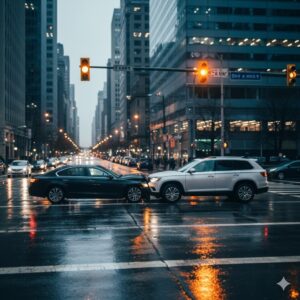
Intersections are, statistically, the most dangerous locations on our roads, but the risk profile peaks specifically during the yellow-light transition period. While a red light presents a clear command to stop and a green light commands movement, the yellow signal provides ambiguous instructions, forcing drivers to make split-second, high-stakes decisions. This brief moment of uncertainty is where drivers’ intentions clash, leading to a disproportionate number of severe collisions.
The yellow light is officially defined as a warning that the signal is about to turn red, demanding that drivers prepare to stop if they can do so safely. However, many drivers illegally treat a yellow light as an opportunity to accelerate and “beat the light,” creating a volatile situation where two conflicting intentions, stopping traffic and clearing traffic, must coexist briefly.
This moment of transition, where compliance and risk-taking collide, explains why crashes at this time are particularly violent, often resulting in T-bone or high-speed head-on impacts. Understanding the chaos of the transition is key to analyzing red and yellow light accidents.
Split-Second Decision Making at Yellow Lights
The core danger of a yellow light lies in the split-second decision-making it demands, which is often dependent on the driver’s location relative to the stop line. A driver who is far from the intersection must decide whether to attempt a hard stop, which risks being rear-ended, or accelerate through, which risks entering the intersection on red.
This “dilemma zone” is defined as the area where the driver can neither stop safely before the light turns red nor clear the intersection before the cross traffic’s signal turns green. Drivers must instantly calculate their speed, the distance to the intersection, and the exact timing of the light cycle, often under pressure.
This cognitive overload leads to human error. Some drivers, rather than making a calculated decision, simply slam on the brakes, causing rear-end collisions, while others gamble and accelerate, setting up the most dangerous scenario: a T-bone crash with traffic turning left or entering the intersection late.
How Conflicting Driver Expectations Cause Crashes
The yellow light phase creates conflicting expectations that are a primary cause of red and yellow light accidents. Drivers facing a yellow light are trying to get through, while drivers facing an imminent green light are preparing to accelerate and enter the intersection, leading to dangerous overlap.
For instance, drivers waiting to turn left often try to squeeze through the intersection during the final milliseconds of the yellow light. If an oncoming driver decides to accelerate to “beat the light,” the turning driver’s expectation of a clear path is violated, leading to a high-speed, dangerous broadside collision.
Furthermore, drivers who have been stopped for a red light often exhibit impatience and begin moving immediately as their light changes to green, failing to check for late-running cross traffic that entered during the tail end of the yellow phase. This premature acceleration greatly increases the risk of a severe impact.
How Speed and Timing Misjudgments Escalate Risk
A key contributing factor to the severity of yellow-light crashes is the speed and timing misjudgment of the drivers involved. The driver trying to beat the light often accelerates past the speed limit to shave off crucial seconds, meaning the resulting collision is much more forceful.
The timing of the light itself is often a factor. If the yellow interval is too short for the posted speed limit, or if the driver misjudges the short clearance interval (the brief moment where all lights are red), they are far more likely to enter the intersection when it is no longer safe.
This combination of excessive speed and poor timing results in the most severe types of accidents, including T-bone impacts where one vehicle strikes the side of another. The higher the speed at the time of the impact, the greater the kinetic energy transfer and the more catastrophic the injuries.
Why Fault Is Harder to Determine in Yellow-Light Collisions
Unlike a crash where one driver clearly ran a red light, determining fault in a yellow-light accident is extremely difficult, often requiring complex traffic engineering and accident reconstruction analysis. Both drivers may claim they were lawfully in the intersection.
Attorneys must rely on eyewitness testimony, surveillance video, and vehicle event data recorders (EDR) to determine the exact moment each vehicle entered the intersection and the speed they were traveling. The key legal question is whether the driver entered the intersection when the light was yellow (potentially legally) or red (clearly illegally).
Because many states apply comparative fault rules, the court may determine that both drivers bear some degree of responsibility for the collision. For instance, the cross-traffic driver may be found partially at fault for accelerating too quickly on green, while the initial driver is primarily at fault for running the light.
Why Yellow Lights Create More Uncertainty Than Red Lights
The yellow light phase is a crucial bottleneck where human instinct, pressure, and uncertainty converge. It forces drivers into a stressful calculus of speed and distance, leading to impulsive decisions that often end in disaster.
This ambiguity makes the legal aftermath of red and yellow light accidents highly complex. Without clear video evidence or objective data, the case often devolves into a difficult contest of competing testimonies, requiring detailed forensic analysis to determine the precise moment of entry.
Ultimately, the yellow light demands caution, but aggressive driving habits turn it into a flashing invitation for severe collisions, underscoring the legal challenges inherent in assigning fault during those dangerous transitional moments.