
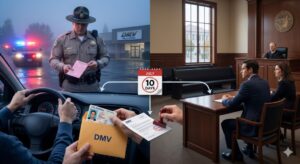

Most drivers arrested for DUI in California assume the criminal court will decide whether they keep their license. They are half right. The criminal case decides one set of consequences; an entirely separate administrative process at the Department of Motor Vehicles decides another — and that second process moves much faster than the first.
The mechanism behind it is California’s implied consent law. It is one of the most misunderstood statutes in DUI practice, and the misunderstanding routinely costs drivers their driving privilege weeks or months before they ever stand in front of a judge.
What Implied Consent Actually Means
Under California Vehicle Code §23612, every person who operates a motor vehicle in the state is deemed to have consented to chemical testing of their blood or breath if they are lawfully arrested on suspicion of DUI. The consent is built into the act of driving itself — the driver does not have to sign anything, and the officer does not need a warrant for the testing to be authorized under the statute.
There are two practical consequences of this design.
First, “I refuse” is a legally meaningful statement, not a passive choice. Refusal carries its own penalties separate from any underlying DUI charge.
Second, the implied consent rule applies only after a lawful arrest. The roadside preliminary alcohol screening (PAS) device — the small handheld breathalyzer offered before an arrest decision is made — is a different category of test, and adult drivers not on DUI probation are generally allowed to decline it without triggering the refusal consequences described below. Drivers often confuse the two, and the confusion can be expensive.
The Two-Track System: DMV vs. Criminal Court
When a driver is arrested for DUI in California, two parallel proceedings begin at the same arrest scene.
The criminal case proceeds in superior court and concerns the actual DUI charge under Vehicle Code §23152 or §23153. It moves on the ordinary timeline of criminal litigation — arraignment, pretrial conferences, motions, possible trial. Months can pass before resolution.
The administrative case proceeds inside the DMV through what is called the Administrative Per Se (APS) process. The arresting officer typically takes the driver’s physical license at the scene, issues a pink temporary license, and forwards a sworn report to the DMV. From that point, the DMV is on its own track to suspend the driving privilege regardless of what happens in criminal court.
These two tracks are formally independent. A driver can be acquitted of DUI in court and still lose their license through APS. A driver can also win the APS hearing and still be convicted criminally. Each forum applies different evidentiary standards, considers different issues, and reaches its conclusions on its own schedule.
The 10-Day Window That Defines the Case
This is where the implied consent framework collides hardest with reality. According to the California DMV’s published guidance, a driver has only 10 days from receipt of the Order of Suspension/Revocation to request an APS hearing. Miss the window, and the right to a hearing is forfeited — the suspension takes effect automatically on the date stated in the order, with no review and no opportunity to challenge the officer’s report. A San Diego DUI defense attorney like those at Randhawa Law Firm will typically use those 10 days to lock in the hearing request, demand discovery from DMV (the officer’s sworn report, calibration records for the testing device, dispatch logs), and begin shaping a defense theory that can run in parallel with the criminal case.
The hearing itself is conducted by a DMV Driver Safety Officer rather than a judge. Standards of evidence are looser than in criminal court, and the issues considered are narrowly defined: whether the officer had reasonable cause to believe the driver was under the influence, whether the arrest was lawful, and whether the driver either submitted to a test showing a BAC at or above the legal limit or refused to complete one. The hearing officer’s role is binary — sustain, modify, or set aside the suspension.
Refusal Carries Its Own Penalties
Refusing a chemical test after a lawful DUI arrest does not make the DUI charge go away. It typically makes things worse on both tracks.
On the DMV side, refusal generally triggers a longer license suspension than a failed test would have produced — often a one-year suspension for a first refusal, with longer revocation periods for subsequent refusals within ten years. The suspension applies even if the underlying DUI charge is later dismissed.
On the criminal side, the refusal can be pleaded as a sentencing enhancement, exposing the defendant to mandatory additional jail time on top of the standard DUI penalties if convicted. Prosecutors may also argue the refusal itself as evidence of consciousness of guilt at trial.
There are limited circumstances in which a refusal can be challenged — for example, where the officer failed to give the statutorily required admonishment, where the driver was physically incapable of completing the test, or where the underlying arrest was not lawful in the first place. Courts generally consider these issues fact-specific, and the strength of any challenge depends heavily on the contents of the officer’s sworn report and the booking video.
Why the Criminal Case and the DMV Case Need Coordinated Strategy
Because the two proceedings are independent but factually overlapping, decisions made in one can affect the other. Testimony given at the APS hearing can be used by the prosecution in the criminal case. Discovery obtained from the DMV — particularly officer reports and testing records — often becomes the foundation for suppression motions in court. A driver who handles the APS hearing without counsel and unknowingly locks in adverse findings can find their criminal defense narrowed before it has begun.
Statutory interpretation in this area also continues to evolve. Recent California appellate decisions have addressed warrantless blood draws, the scope of the implied consent rule when a driver is unconscious, and the admissibility of refusal evidence — all areas where the answer depends on jurisdiction-specific precedent and the precise facts of the stop.
The Practical Takeaway
A DUI arrest in California is not one legal problem. It is two, running on different clocks, decided by different decision-makers, and governed by overlapping but distinct rules. The implied consent law is the bridge between them — and the 10-day APS window is the first deadline most drivers do not realize they are facing.
Treating the arrest as a single criminal matter and waiting for the court date is the most common — and most consequential — mistake a driver can make. By the time the criminal case is resolved, the administrative suspension has often already taken full effect.