
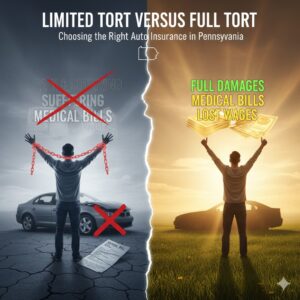
When purchasing car insurance in Pennsylvania, one of the most important decisions drivers face is choosing between Limited Tort and Full Tort coverage. This choice determines the extent of your legal rights after an accident and can significantly affect the compensation you’re able to recover. Careful consideration of these options is crucial. A knowledgeable car accident attorney in Pennsylvania can help you evaluate which coverage best protects your financial and personal interests.
The Financial Disparity: Defining Full and Limited Tort
When choosing between Full Tort and Limited Tort coverage in Pennsylvania, the most critical difference lies in a driver’s right to seek compensation for non-economic damages, the deeply personal losses that do not come with a receipt but can have the greatest impact on one’s life.
Full Tort Option
Under Pennsylvania law, selecting the Full Tort option grants you and your household members an unrestricted right to pursue legal action for all damages resulting from another driver’s negligence. This includes the ability to sue in court for full damages, covering two key categories of loss:
- Economic Damages: These cover your measurable financial losses, such as hospital bills, rehabilitation costs, property damage, and lost wages.
- Non-Economic Damages: These involve the human toll of an accident, including pain and suffering, emotional anguish, embarrassment, humiliation, and the loss of life’s enjoyment.
With Full Tort coverage, accident victims maintain full control over their legal rights, ensuring they can seek compensation for both the tangible and intangible consequences of a crash.
Limited Tort Option
Choosing the Limited Tort option, on the other hand, places significant restrictions on your ability to recover non-economic damages. While you can still claim medical expenses and other out-of-pocket costs, you generally cannot seek compensation for pain and suffering or other nonmonetary losses, unless your injuries meet Pennsylvania’s legal definition of a “serious injury” or fall under another statutory exception.
The main appeal of Limited Tort coverage is its lower cost. Insurers often advertise savings of around 15% to 20%, which may amount to just $100 to $200 per year. However, these modest savings can come at a steep price. If you suffer a life-changing injury, you may be unable to recover compensation for the physical pain, emotional trauma, and long-term suffering that often make up the largest portion of a personal injury claim.
The “Serious Injury” Threshold
The Limited Tort option includes one important exception that allows an accident victim to recover non-economic damages if they suffer a “serious injury.” This provision often leads people to believe that any major or painful injury will qualify, but the legal definition is much stricter.
How Pennsylvania Law Defines a Serious Injury
Under Pennsylvania’s Motor Vehicle Financial Responsibility Law, a “serious injury” is defined as a “personal injury resulting in death, serious impairment of bodily function, or permanent serious disfigurement.” The challenge lies in interpreting “serious impairment of bodily function.” This phrase is not a clear medical term but a legal standard that requires a case-specific analysis.
Because of this ambiguity, insurance companies often argue that many severe injuries do not meet the legal threshold. As a result, many Limited Tort policyholders are surprised to find that their injuries, while significant, do not legally qualify as “serious.”
Real Cases Illustrate the Challenge
Court decisions in Pennsylvania show how difficult it can be to meet this requirement:
- A man who fractured both sides of his jaw, had it wired shut for 14 weeks, and lost 20 pounds was told his injuries were not “serious” under the law. He was denied compensation for pain and suffering.
- A woman who fractured a vertebra, required hospitalization, wore a back brace, and was unable to bend at the waist was also found not to have suffered a “serious injury.” She received nothing for her suffering.
Why Legal Representation Matters
Overcoming the “serious injury” threshold requires legal skill, not just medical proof. Pennsylvania courts have recognized that an injury need not be permanent to be serious, and that a person’s subjective experience of pain can sometimes qualify.
A successful claim often depends on how effectively an attorney can apply legal precedent to the facts of a case. Meeting this threshold is a legal challenge that demands careful argument, detailed documentation, and experienced representation to secure the compensation a victim deserves.
Statutory Exceptions That Restore Full Tort Rights
For many Pennsylvanians who have already chosen Limited Tort coverage, there may still be a way to recover compensation for non-economic damages. Even if an injury does not meet the demanding “serious injury” standard, Pennsylvania law recognizes several exceptions that automatically grant Full Tort rights for the purpose of a claim.
It is the injured person’s responsibility to prove that one of these exceptions applies. This makes a detailed investigation into the accident’s circumstances essential, since specific factors involving the at-fault driver, vehicle, or situation can determine whether Full Tort rights are restored.
- The At-Fault Driver Was Drunk: If the driver who caused the accident was convicted of Driving Under the Influence (DUI) or entered Accelerated Rehabilitative Disposition (ARD), the Limited Tort restriction no longer applies.
- The At-Fault Vehicle Was Registered Out of State: If the vehicle that caused the crash was registered outside Pennsylvania, such as in New York, Ohio, or West Virginia, the injured person’s Limited Tort election does not limit their recovery rights.
- The At-Fault Driver Was Uninsured: If the at-fault driver lacked insurance, a limited-tort plaintiff may pursue non-economic damages against that driver. However, Pennsylvania §1731(d)(2) bars recovering non-economic damages from your UM/UIM policy unless you meet the serious-injury threshold.
- The Victim Was a Pedestrian or Bicyclist: Limited Tort applies when an insured is an occupant of a private passenger motor vehicle; it binds all insureds on the policy, not only when they are in their own car. If someone is hit as a pedestrian or bicyclist, their tort election does not restrict their ability to recover damages. The Pennsylvania Supreme Court confirmed this principle in L.S. v. Eschbach (2005).
- The Victim Was in a Non-Private Passenger Vehicle (e.g., bus, taxi, some rideshares): §1705(d)(3) restores full-tort rights. Whether Uber/Lyft counts can be fact-specific; many treat rideshares as non-private (livery), but Pennsylvania courts have noted gray areas.
- The At-Fault Driver Acted Intentionally: When the at-fault driver intended to cause harm, such as in an act of road rage or deliberate collision, the Limited Tort limitation is lifted, allowing the victim to pursue full damages.
- The Accident Was Caused by a Vehicle Defect: If the injury resulted from a vehicle defect in design, manufacturing, repair, or maintenance, the victim may bring a claim against the manufacturer or repair facility for non-economic damages, regardless of their tort selection.
These statutory exceptions are crucial for Limited Tort policyholders because they can dramatically change the outcome of a personal injury claim. Many accident victims who initially believe they are restricted by Limited Tort discover that their case actually qualifies for Full Tort protection once the proper facts are uncovered.
Making the Smart Choice: Why Full Tort Often Pays Off
While Limited Tort coverage may seem appealing for its slightly lower premiums, it can leave you without the ability to recover compensation for pain, suffering, and other life-changing losses after an accident. The amount saved each year is rarely worth the significant legal limitations it creates when you need protection most.
Choosing Full Tort coverage ensures that you retain complete control over your right to pursue justice and full financial recovery. It provides peace of mind knowing that if you are injured, you can seek compensation for both your economic and non-economic damages.