
Slip-and-fall accidents on New York City sidewalks happen every day, often resulting in serious injuries and expensive medical bills. What many people do not realize is that responsibility for these accidents usually does not fall on the City itself. Careful consideration of who can be considered liable can determine whether a victim receives compensation or faces a denied claim. If you or someone you love has been injured in a sidewalk fall, a slip or fall lawyer in Kings County can help investigate the cause, identify the responsible party, and protect your right to recover damages.
How § 7-210 Shifted Sidewalk Liability
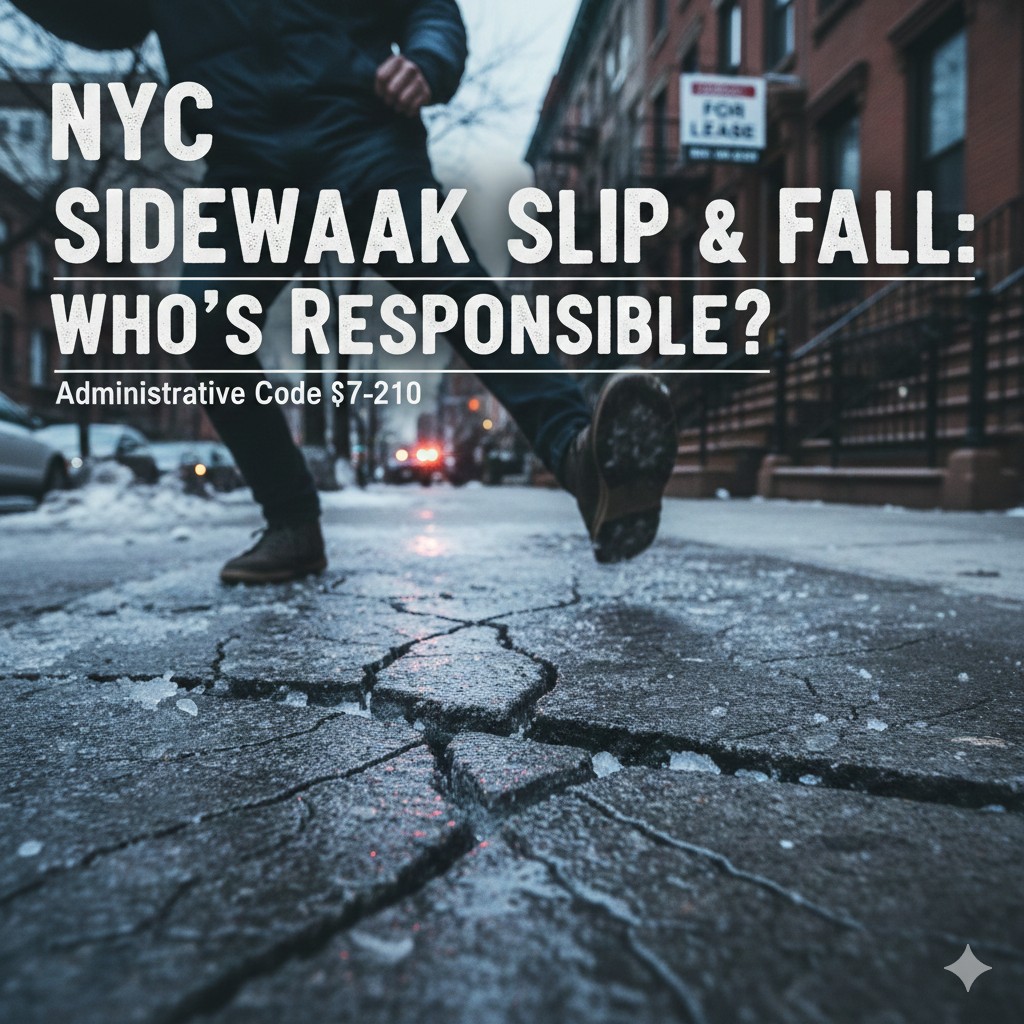
Before 2003, responsibility for maintaining New York City’s more than 12,750 miles of sidewalks rested primarily with the City itself. The result was predictable: countless defects, uneven pavement, and an overwhelming number of personal injury claims against the City. In response, lawmakers enacted Administrative Code § 7-210, shifting the duty of sidewalk maintenance and liability to most adjacent property owners.
- The Duty: Under § 7-210(a), “It shall be the duty of the owner of real property abutting any sidewalk… to maintain such sidewalk in a reasonably safe condition.” In plain terms, property owners must keep their sidewalks safe for pedestrians.
- The Liability: Subsection (b) reinforces that duty with liability: an owner “shall be liable for any injury… proximately caused by the failure of such owner to maintain such sidewalk in a reasonably safe condition.”
This duty is comprehensive. “Failure to maintain” covers not only visible defects such as cracks, holes, and uneven surfaces but also the negligent failure to remove snow, ice, dirt, or other debris. In short, sidewalk safety encompasses both structural upkeep and seasonal maintenance.
A Non-Delegable Duty
Perhaps the most consequential feature of § 7-210 is that the duty it imposes is non-delegable. Even if a landlord leases out the property and shifts maintenance responsibilities to a tenant through a private agreement, the owner remains legally responsible to the public.
The New York Court of Appeals underscored this point in Xiang Fu He v. Troon Management, Inc.: an “out-of-possession” commercial landlord cannot escape liability under § 7-210 simply because a lease requires the tenant to handle sidewalk care. While that lease may allocate costs or duties between landlord and tenant, it does not absolve the property owner’s ultimate obligation to maintain a safe sidewalk. This means an injured pedestrian can sue the property owner directly, even if the tenant agreed in writing to handle maintenance.
When the Property Owner Isn’t Liable: Key Exceptions to § 7-210
Administrative Code § 7-210 is powerful, but it is not absolute. Determining who is responsible for a sidewalk defect requires a careful look at both the type of property and the precise location of the hazard. Failing to identify the correct defendant at the start of a case can be a costly mistake that jeopardizes the entire claim.
The 1-2-3 Family Home Exception
The most significant exception to § 7-210 applies to certain residential properties. The statute specifically excludes “one-, two-, or three-family residential real property that is (i) in whole or in part, owner-occupied, and (ii) used exclusively for residential purposes.”
This exception creates a narrow three-part test. If all these criteria are met, the property owner is exempt from sidewalk liability under § 7-210. In such cases, responsibility shifts back to the City of New York.
However, pursuing a claim against the City is considerably more challenging. Under New York’s Pothole Law, an injured pedestrian must prove that the City had prior written notice of the exact defect that caused the accident. Without this documentation, typically a record from the Department of Transportation’s inspection system, the City cannot be held liable.
Adding to the difficulty, a claimant must file a Notice of Claim within 90 days of the incident. Missing this deadline usually results in a complete loss of the right to recover compensation. These procedural hurdles make prompt legal action and thorough investigation essential.
The City Retains Responsibility for Its Property
Even with § 7-210 in place, the City of New York remains responsible for certain sidewalks and structures that fall outside the statute’s scope. The law applies only to the “sidewalk,” and courts have defined that term narrowly through a series of decisions.
The City continues to bear responsibility for:
- Curbs: Courts have consistently ruled that curbstones are not part of the sidewalk. Property owners are not liable for defects in curbs.
- Tree Wells: City-owned tree wells or tree pits are also excluded. In Vucetovic v. Epsom Downs, Inc., the court confirmed that § 7-210 does not impose liability on property owners for injuries occurring in or around tree wells.
- City-Owned Infrastructure: The City remains responsible for sidewalks abutting its own property, including public parks, schools, and government buildings. The City or utility companies remain responsible for installations like manhole covers, grates, and street hardware, including a twelve-inch perimeter around them (34 RCNY § 2-07[b]). The City is also responsible for bus stop areas, signposts, and other public fixtures in the right-of-way.
While § 7-210 dramatically shifted liability to private property owners, several exceptions preserve the City’s role in maintaining safe pedestrian spaces. Understanding where those boundaries lie is critical for both property owners and injured pedestrians seeking justice.
Steps to Take After a Sidewalk Fall: Protecting Health and Preserving Evidence
The moments after a slip and fall are chaotic. Health and safety should always come first, but the actions an injured person takes can also play a major role in protecting their legal rights.
- Seek Immediate Medical Attention: This is the most important step for both personal health and any future claim. Some serious injuries, including concussions or internal injuries, may not be obvious right away. Getting prompt medical care creates an official record that connects your injuries to the fall. Waiting days or weeks to see a doctor can give the defense a chance to argue that your injuries are unrelated or not serious.
- Document the Scene if Safe: This is an urgent step because sidewalk hazards are often temporary. Snow and ice can melt, and once a property owner learns about a fall, they may repair a crack or clean a spill quickly. The evidence can disappear within hours.
- Gather Witness Information: If anyone saw the fall or the hazardous condition, ask for their name and contact information. Witness testimony can be extremely valuable in proving what the sidewalk looked like at the time of the incident.
- Report the Incident: File an incident report with the property owner, building manager, or store. This creates an official record of the event. You can also report the dangerous condition to NYC 311 to create a public record. Keep in mind that while this can help document the issue, a 311 complaint alone usually does not count as the ‘prior written notice’ required for claims against the City.
- Preserve Physical Evidence: The defense may argue that your shoes or clothing contributed to the fall. To protect your case, place the shoes and clothing you were wearing in a sealed bag and do not wear them again.
- Keep All Records: Start a file and save everything related to the incident. Keep copies of medical records, bills, receipts for co-pays or prescriptions, and any documents showing lost wages, such as pay stubs.
Holding the Right Party Accountable After a Sidewalk Fall
The aftermath of a sidewalk slip-and-fall in New York City can be overwhelming. Between medical recovery, complex liability laws, and strict filing deadlines, it is easy to make a costly mistake without experienced legal guidance. If you were injured because of a broken sidewalk, uneven pavement, or unremoved snow or ice, do not wait to seek help. A Brooklyn slip and fall accident attorney can review your case, gather critical evidence, and ensure your claim is filed correctly and on time. You deserve compensation for your injuries and peace of mind knowing your rights are protected.